
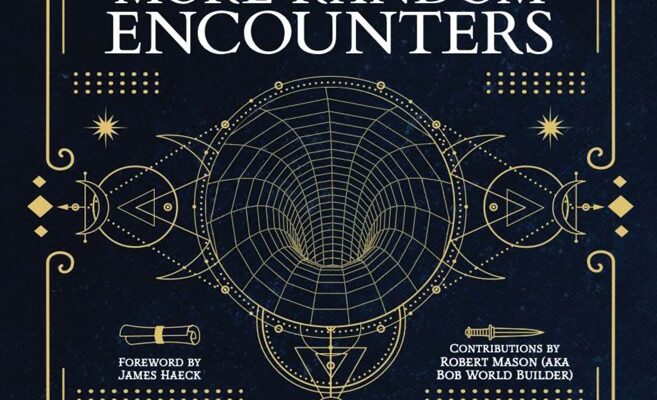
This sequel is exactly what it says on the tin: more locations, more prompts, more ways to keep the session moving when your party sprints off your prep. Where the original focused on grounded fantasy haunts (taverns, temples, tombs), More Random Encounters dials up the range—from practical sites to extraplanar and even extraplanetary destinations—so you can pivot your game from “we need an inn” to “we fell through a portal to… what?” without breaking stride. The book targets 5e tables and is positioned as drop-in support for any ongoing campaign.
🗺️ What’s Inside (Publisher/Retailer Highlights)
- “500+ more” maps, roll tables, and story hooks, expanding the original’s toolkit with fresh scene seeds and complications.
- Three one-shot adventures you can plug into a campaign when you need a full evening’s content.
- A broad location catalog—from inns and alchemists’ labs to far-off planes and stranger places—that pairs each map with tables to vary the purpose, hazards, and rewards.
- Copy is pitched as compatible with your 5e adventures, keeping mechanics and assumptions tuned to that ecosystem.
The official sales copy also emphasizes “far-off realms… farther-off planes… and even the farthest reaches of the galaxy,” which telegraphs the book’s willingness to push tone and scope beyond vanilla fantasy when you want it.
⚙️ At-the-Table Workflow (Why It’s Useful in Play)
The sequel follows the same LEGO-brick philosophy that made the first book so handy:
- Pick a destination that matches where (or when) the party just blundered—mundane, extradimensional, or delightfully odd.
- Roll a few tables to inject motive and texture (who’s here, what’s happening, what’s about to go wrong).
- Thread a hook—a missing courier, a cursed relic humming underfoot, a patron with a problem—to give players a reason to engage.
- Escalate into one of the three one-shots if the group lingers or you need a complete arc.
Because each entry combines map + tables + prompts, you’re never just naming an NPC; you’re conjuring a playable situation with stakes and momentum. That makes it especially valuable for West Marches, hex-crawls, or any campaign where player agency routinely outpaces prep.
✨ What’s New vs. the First Book
- Wider tonal bandwidth. The sequel’s mandate to hit planes and planets means you can frame scenes that feel fresh even to veteran groups—think planar diners, gravity-weird lairs, or temples at the edge of reality.
- Variant tables per map. Rather than a single static use, locations gain range through mix-and-match complications, letting you revisit the same site with a different vibe or objective.
- Pack-and-play one-shots (x3). A smaller set than the first book’s eight, but focused; ideal as pressure-release valves on busy nights.
🧰 Strengths (Why It Earns Table Space)
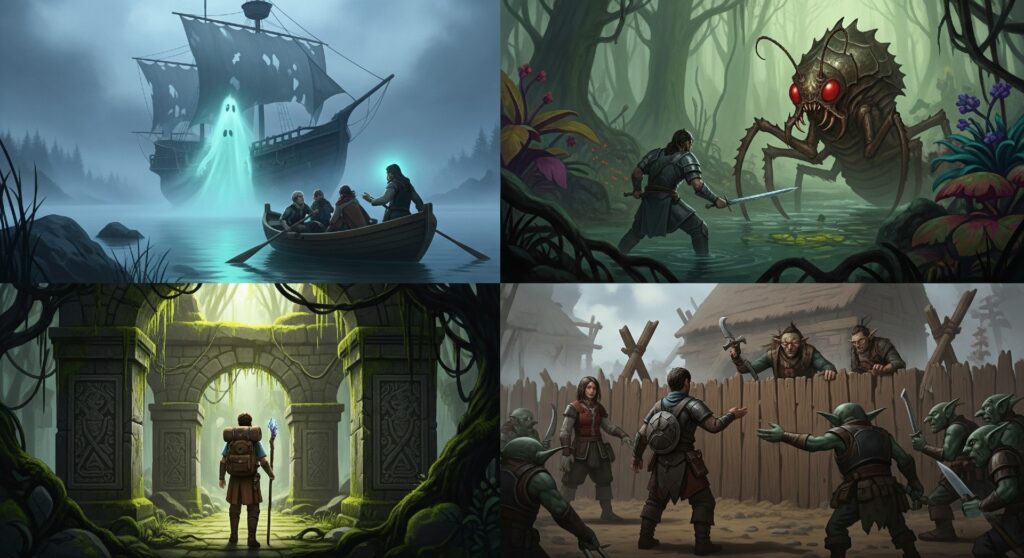
- Speed without thinness. The tables don’t just color the scene; paired with maps and hooks, they produce situations—conflicts, discoveries, choices—fast.
- Range for every mood. Need cozy downtime? There’s an inn with secrets. Need a curveball? Plane-hopping or cosmic weirdness is on tap without switching systems.
- Session funnels. The three one-shots act as catch-alls when attendance is light or the main plot needs a breather.
- 5e alignment. If your table speaks 5e, you’ll spend zero time translating assumptions; the support text aims squarely at that ruleset.
⚠️ Limitations (What to Watch)
- 5e-first voice. It’s easy to poach for other systems because the content leans narrative, but OSR/narrative-first GMs will still make small conversions and recalibrate difficulty by feel. (Positioning and system tag verified.)
- Randomness needs curation. As ever with roll tables, results shine when you cherry-pick to match your campaign’s tone. Roll slavishly and you might whipsaw from whimsical to grim without warning.
- Fewer one-shots than Book 1. You get three here (not eight), so if you relied on the first book as an adventure anthology, the sequel is more encounter engine than mission pack.
🧩 Where It Fits in the Series
Media Lab’s Game Master line has become a toolkit shelf: Random Encounters (the original), this sequel, plus adjacent aids like Non-Player Characters, Traps, Puzzles & Dungeons, Instant Towns & Cities, and Legendary Locations. If More Random Encounters clicks, it pairs naturally with Instant Towns & Cities for urban play or Legendary Locations for set-piece sites—several are surfaced alongside this title in retailer catalogs.
🧾 Verdict
The Game Master’s Book of More Random Encounters does what a sequel should: it expands the canvas and raises the ceiling. You still get the plug-and-play speed that turns empty minutes into memorable scenes; now you also get the latitude to go wider and weirder without losing 5e usability. If your table thrives on exploration and improvisation—or if you’re the GM who often needs a Friday-night safety net—this belongs within arm’s reach. For tightly scripted campaigns it’ll be a color and side-quest mine; for open worlds and West Marches, it’s a session-saver you’ll use again and again.