
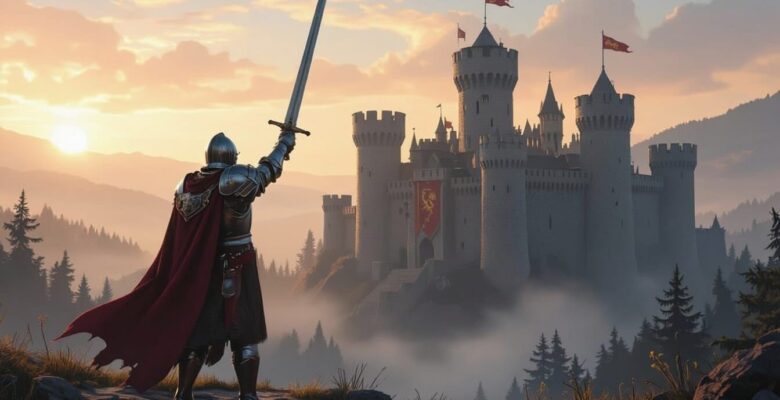
Castles & Crusades (C&C) is a fantasy role-playing game built to capture the feel of early Dungeons & Dragons play while using a unified, modernized resolution system. Rather than cloning a single edition of D&D, C&C strips away some of the bloat that accompanied later editions and replaces it with a compact, unified mechanic set called the SIEGE Engine. The goal: quick character creation, fast play, and a focus on improvisation and rulings over reference-heavy adjudication. The line has expanded into a full family of books (Player’s Handbook, Castle Keeper’s Guide, monsters, adventures, and setting material) and remains Troll Lord Games’ flagship product.
⚙️ The SIEGE Engine — simple, unified resolution
The SIEGE Engine is the most important mechanical departure from traditional d20: instead of separate attack rolls, saving throws, and disparate subsystems, C&C uses an attribute check / challenge class approach. Attributes are classed as primary or secondary; checks against primary attributes use a Challenge Base (CB) of 12 while secondary attributes use a CB of 18, and the Castle Keeper adds a difficulty level (1–10) to form the final Challenge Class (CC). Players roll a d20, add level and bonuses, and compare to the CC — success is binary and fast. This single mechanic covers skill checks, saves, and many contested actions, which keeps adjudication speedy at the table.
🧱 Character design & classes — legacy with options
Character creation will feel familiar to anyone with roots in classic D&D: you choose a race (ancestry) and class, roll or assign ability scores, pick equipment and spells, and select class features. The Player’s Handbook and subsequent printings refine options and add authorship from a broad creative team. Classes are intentionally archetypal—fighters, wizards, clerics, thieves (and variants)—so players get the recognizable roles of swords & sorcery without overwhelming mechanical branches. Advancement is straightforward, tying level to bonuses in the SIEGE checks rather than a proliferation of micro-feats.
🧙 Magic, monsters, and old-school tone
Magic in C&C reads as traditional and functional: spells are evocative but resolvable within the SIEGE framework rather than becoming a separate subsystem. The bestiary and monster supplements preserve that pulpy, hazardous feel: monsters are dangerous, environments are punishing, and the line nudges GMs toward creating a sense of wonder and risk rather than optimization-driven play. Troll Lord also published setting and adventure books (Aihrde material and modules) so groups can either create their own worlds or run prebuilt campaigns.
🧭 How it plays at the table — flow and tone
At the table C&C usually plays faster than many modern d20 variants because the SIEGE Engine consolidates resolution and reduces special-case rules. Combat remains tactical but brisk; checks and saves are consistent; and the emphasis is on the Castle Keeper’s rulings rather than hunting through multiple subsystems. Games tend to favor exploration, dungeon delving, and the kind of improvisational problem solving that older D&D rewarded. That said, GMs looking for simulationist crunch or hyper-detailed tactical subsystems may find the system lighter than they prefer.
🕰️ Lineage, editions, and community role
C&C arrived in 2004 and quickly established itself as both a pragmatic d20-style ruleset and a torchbearer for old-school sensibilities; reviewers and historians credit it as an influence on the Old School Revival movement because of how it packaged classic play patterns in a modern, cleaner ruleset. Troll Lord Games has continued to support the line with reprints and new supplements (Castle Keeper’s Guide, monster anthologies, campaign bundles), and the game enjoys an active community and steady catalogue of third-party material.
✨ Strengths — why many groups pick C&C
- Unified mechanics = faster play. The SIEGE Engine’s single-check approach significantly reduces bookkeeping and lookup time, which keeps scenes moving.
- Old-school feel without archaic rules. It captures the improvisational table dynamic of early D&D while giving modern designers’ clarity and consistency. Historians and reviewers note its role in reviving OSR attitudes.
- Modular support & longevity. Troll Lord’s steady stream of supplements, settings (Aihrde), and reprints means buyers get a growing ecosystem rather than a single book.
- GM-friendly design. The line encourages rulings-over-rules, leaving the Castle Keeper space to adjudicate creatively rather than be gatekept by pages of corner cases.
⚠️ Caveats — where it might not fit your table
- Less crunch for power gamers. Players who relish granular combat modifiers, tactical minutiae, or deep subsystem optimization may find C&C intentionally lightweight. The tradeoff is speed and narrative flexibility.
- Rulings-heavy tables require a decisive GM. While the system reduces rule friction, it assumes a Castle Keeper willing to make calls and shape scenes; inexperienced GMs may need time to become confident in that role.
- Edition confusion for newcomers. Over the years Troll Lord has issued multiple printings and special editions (collector boxes, bundles), which can make tracking “the current recommended print” a little confusing for new buyers—check the publisher pages for the latest printing.
📚 Production & physical editions
Troll Lord’s releases have included a variety of physical configurations: the white-box first edition, hardcover Player’s Handbooks, Castle Keeper guides, and occasional collector editions. Production values range from functional to attractive, with cover art by notable genre illustrators and interior art that suits the classic fantasy tone. Troll Lord’s product pages and bundles collect current printings and supplements for buyers who want a complete set.
🧭 Who should try Castles & Crusades?
- You should try it if you want a fantasy RPG that recreates old-school table dynamics (exploration, hazard, mystery) but packaged in a modern, unified mechanic. It’s ideal for groups who prefer fast adjudication and a GM-led sandbox.
- You might skip it if your table favors heavy tactical simulation, deeply detailed character build trees, or very crunchy subsystem warfare (in which case other OSR or simulationist games might be better fits).
🗡️ Final verdict

Castles & Crusades is a focused, elegant melding of old-school sensibility and modern design discipline. Its SIEGE Engine keeps play brisk, its line of supplements gives endurance and variety, and its tone rewards improvisation and exploration. Whether you’re returning to the feel of early D&D or seeking a streamlined fantasy system that runs long campaigns without rule bloat, C&C is a robust, well-supported option. It won’t satisfy every playstyle, but for groups that prize pace, tone, and GM authority, it remains one of the most coherent alternatives to the mainstream fantasy RPG field.