
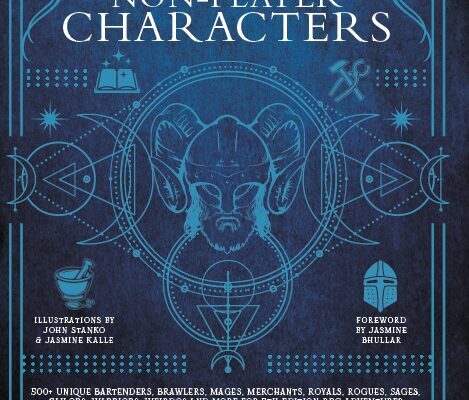
The Game Master’s Book of Non-Player Characters promises exactly what the book delivers: a hefty, ready-to-use compendium of prebuilt NPCs for GMs who want believable faces and motivations on demand. If you’ve ever watched a session stall because the innkeeper felt like an empty set dressing, this volume is designed to give you hundreds of interesting people — quick — and a set of simple conventions to bring them to life.
🧭 What’s in the book (at a glance)
The book collects over 500 NPCs spanning archetypes (bartenders, merchants, nobles, sages, brigands, weirdos, and more), each sketched with a few lines of personality, goals, and a hook for adventure. The volume runs roughly 272 pages and is part of Topix Media Lab’s growing “Game Master’s Book” line.
A few extras sweeten the deal: the edition includes more than fifty hand-drawn NPC illustrations, three short one-shot adventures that use the NPCs, and a foreword from an online influencer (noted in retailer listings). These features make the book both a visual reference and a practical toolkit.
🛠️ Usability at the table (the core value)
This book’s primary strength is pragmatic immediacy. Entries are intentionally short — usually a single paragraph plus a couple of standout details — so the GM can scan, pick, and drop an NPC into play in seconds. For GMs running fast-moving sessions, that speed matters more than depth: you don’t need a mini-novel for a bar brawl or a roadside encounter.
Design choices that increase usability:
• One-look readability. NPCs are presented in a compact form: name, role, defining trait(s), brief motivation, and a suggested twist or hook. This structure foregrounds what players will notice and what the GM can use to steer a scene.
• Categorization. Characters are grouped by role and locale, which means if your players veer into a ship’s galley you can flip to “sailors / crew” and find a dozen inserts suited to the environment.
• Re-usable hooks. Most NPCs include a short conflict line or secret that can easily seed a side quest or social complication without mechanical prep.
These design choices make the book a genuine “screen tool.” Instead of rooting around notes, a GM can glance and have an NPC with a distinct voice and agenda the moment one is required.
🎨 Presentation and modular extras
Topix Media Lab’s production choices support usability. The hardcover and digital layouts are clean; illustrations help anchor memorable faces to names, which is useful when you want an evocative prompt but don’t want to invent new features on the spot. The inclusion of three micro-adventures that make use of the NPCs is also practical: they demonstrate how to convert a handful of entries into a playable scene.
One small caveat: the book’s tone and naming conventions lean toward classic Western fantasy and D&D-style play. GMs running historical, sci-fi, or strongly exotic settings will find most entries adaptable, but some reworking (names, culture, or social mechanics) might be required.
⚖️ Strengths and tradeoffs
Strengths
- Massive catalog — 500+ NPCs reduces “blank NPC” anxiety and supports improvisation.
- Immediate playability — short entries and hooks make insertion trivial.
- Illustrations & examples — visual anchors and the included micro-adventures model how to use NPCs beyond token lines.
- Good value — the 272-page production provides a lot of content for the price point listed on major retailers.
Tradeoffs
- Shallow mechanical support. The book focuses on flavor and roleplay hooks rather than stat blocks. GMs using crunchy systems will need to convert NPCs mechanically.
- Potential repetition. With hundreds of entries there’s inevitable overlap; not every NPC will be a masterpiece. The value comes from having options rather than perfection.
- D&D-centric framing. It integrates most cleanly into 5e or similar fantasy systems; conversion is necessary for other genres.
🧩 How to use this book effectively
- Use it as a spice rack, not a script. Pull two or three traits to flavor an encounter rather than using the NPC verbatim.
- Mix and match hooks. Combine motivations, secrets, and one-line histories to create layered allies or antagonists.
- Prep banks. Before a session, jot three NPCs into a “ready” bank: tavernkeeper, messenger, town guard. Keep the book at hand and swap them in as needed.
- Stat conversion cheat. Create a few stat archetypes (e.g., “Commoner A: AC 10, HP 4, Attack +2”) and apply them to NPCs on the fly.
👥 Who should buy it?
This is a must for GMs who run improvisational tables, one-shots, or sandbox campaigns where players regularly visit new locations. It’s also excellent for new GMs who want to learn how to create distinct NPC moments without writing pages of lore. Crunch-first GMs will still find it useful, but should budget a few minutes to add mechanics.
✅ Final Verdict
The Game Master’s Book of Non-Player Characters does exactly what it promises: it supplies a wealth of instantly deployable NPCs and the small supporting materials (illustrations, examples, micro-adventures) that make them usable at the table. It’s not a mechanical toolkit — you’ll need to translate when rules precision matters — but for pure roleplay, improvisation, and session flow, it’s an exceptional reference.
If your sessions hinge on sharp, quick social beats or you regularly field spontaneous player choices, this book will become one of your most used shelf tools. For those who demand complete stat blocks and system-locked rules, pair this book with a compact stat conversion sheet to turn flavor into function in seconds.
Bonus Content: 25 Instant NPCs
Here are some NPC ideas you can drop in your game tonight.
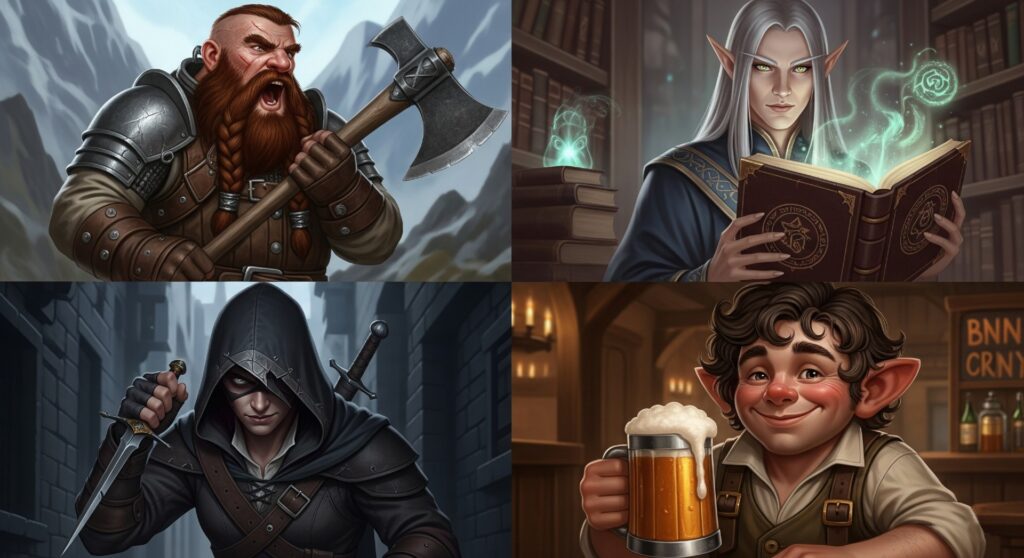
Tavern / Inn
Mira Hearthhand – Innkeeper (Warm, perceptive)
Hook: Knows a secret about every guest who stays.
Jorn Aleborn – Barkeep (Gruff, loyal)
Hook: Will trade rumors for rare spirits.
Sella Quickpour – Barmaid (Cheerful, nosy)
Hook: Steals small items from inattentive patrons.
Tobias Muggs – Cook (Irritable, proud)
Hook: Once cooked for a visiting noble who never paid.
Fendrel Stoutcap – Bouncer (Stoic, intimidating)
Hook: Refuses service to anyone wearing blue.
City Streets
Harrin Lockjaw – Guard (Suspicious, dutiful)
Hook: Keeps a ledger of everyone’s comings and goings.
Pella Whitfoot – Messenger (Eager, forgetful)
Hook: Has a package she can’t remember who to deliver to.
Karn the Hand – Pickpocket (Sly, overconfident)
Hook: Stole something cursed without realizing.
Old Maev – Street Vendor (Chatty, superstitious)
Hook: Sells charms she claims keep away ghosts.
Rook Cinders – Urchin (Resourceful, quiet)
Hook: Knows every rooftop and alley in the district.
Wilderness
Lysa Thornhide – Hunter (Practical, fearless)
Hook: Tracks a beast she believes killed her brother.
Brannic Mossbeard – Herbalist (Gentle, reclusive)
Hook: Brews a potion that works too well.
Eorin Swiftbranch – Scout (Sharp-eyed, cautious)
Hook: Saw an army moving through the forest at night.
Garr the Lone – Hermit (Grumpy, wise)
Hook: Speaks to stones as if they listen.
Thalia Frostwind – Guide (Optimistic, patient)
Hook: Knows a shortcut but demands payment upfront.
Villains & Rogues
Verrik Bloodsmile – Bandit Leader (Charismatic, cruel)
Hook: Keeps trophies from every victim.
Selra the Pale – Assassin (Cold, methodical)
Hook: Accepts payment in memories.
Dorn Ironshank – Crime Boss (Ambitious, vengeful)
Hook: Controls the city’s underground fights.
Maelis the Ash – Arsonist (Eccentric, obsessed)
Hook: Burns only buildings tied to a single family name.
Kraven Holt – Smuggler (Greedy, charming)
Hook: Knows a hidden dock untouched by lawmen.
Specialists & Oddities
Vetra Glass – Artisan (Meticulous, aloof)
Hook: Crafts stained glass depicting future events.
Fennel Quill – Scribe (Curious, meek)
Hook: Writes letters for ghosts.
Joria Windtune – Bard (Enthusiastic, dramatic)
Hook: Composes songs that change the weather.
Drask Hollow – Gravekeeper (Quiet, grim)
Hook: Talks to graves as if they answer.
Orrin Starcall – Astrologer (Dreamy, cryptic)
Hook: Predicted the end of the world three times.