
Publisher: Schwalb Entertainment
System: Weird Wizard (original system, spiritual successor to Shadow of the Demon Lord)
🔍 Introduction
Secrets of the Weird Wizard is the first major expansion for Shadow of the Weird Wizard, the lighter-toned, high fantasy sibling of Shadow of the Demon Lord. But while players might expect new paths, spells, or crafting mechanics from a traditional supplement, this book takes a different approach. Instead, it focuses squarely on the Game Master’s side of the screen—offering philosophical advice, an adventure-ready sandbox setting, and a robust bestiary to flesh out your campaign world.
With its mixture of practical guidance and game-ready content, Secrets of the Weird Wizard is not a mechanical expansion but a toolkit for running the game more smoothly and vividly.
🧠 Chapter 1: Sage Advice
The first chapter, “Sage Advice,” is a tight but thoughtful piece of GM-centric writing. Rather than restating rules or offering system clarifications, it serves as a philosophical guide for how to run Shadow of the Weird Wizard in the spirit it was designed.
Topics include:
- Saying “yes” to player creativity
- Making rulings quickly and fairly
- Prioritizing fun and narrative over rigidity
- Embracing improvisation as a tool, not a risk
The tone here is light and encouraging. Schwalb repeatedly emphasizes that Weird Wizard is meant to be flexible and fast-moving—not a game of gotchas or legalistic rule parsing. This section may not offer concrete charts or tools, but it helps align a GM’s mindset with the game’s whimsical, adventurous tone.
It’s especially helpful for GMs new to narrative-forward systems or those transitioning from crunchier traditions.
🧭 Chapter 2: Borderlands
This is the heart of the book. The Borderlands chapter presents a detailed, open-ended sandbox setting that GMs can use as a starting point or expansion for their Weird Wizard campaigns.
📌 The Setup
The Borderlands are described as a newly reclaimed frontier region—a place once ruled by chaos and monsters, now tenuously settled by brave (and sometimes foolish) folk. It’s a classic fantasy frontier, but one flavored by Weird Wizard’s charm, danger, and strangeness.
The chapter is divided into:
- Overviews of each subregion (forests, hills, marshes, ruins)
- Tables of rumors, encounters, and factions
- Notable locations: ruined forts, forgotten tombs, mysterious shrines
- Villages and strongholds, each with NPCs, goals, and local conflicts
- Adventure seeds tied to monsters, magical events, or power struggles
Everything is modular. There’s no overarching plot to follow—instead, the book offers a flexible framework for GMs to build story arcs, faction drama, or exploration-based campaigns at their own pace.
🎯 What Makes It Effective?
- Playable Immediately: You can drop your party into the Borderlands with zero prep.
- Narrative Density: Every page has hooks, rumors, or potential threats.
- Tone Consistency: The content matches Weird Wizard’s brand of peril and wonder—ghost-haunted woods, relics of a fallen empire, scheming guilds, oddball NPCs.
- GM Freedom: It’s not a railroad or even a single storyline. It’s a rich sandbox, and the party shapes the direction.
In short, this chapter is a ready-to-run region that could host months of gameplay with little more than a session or two of GM prep.
👹 Chapter 3: Bestiary
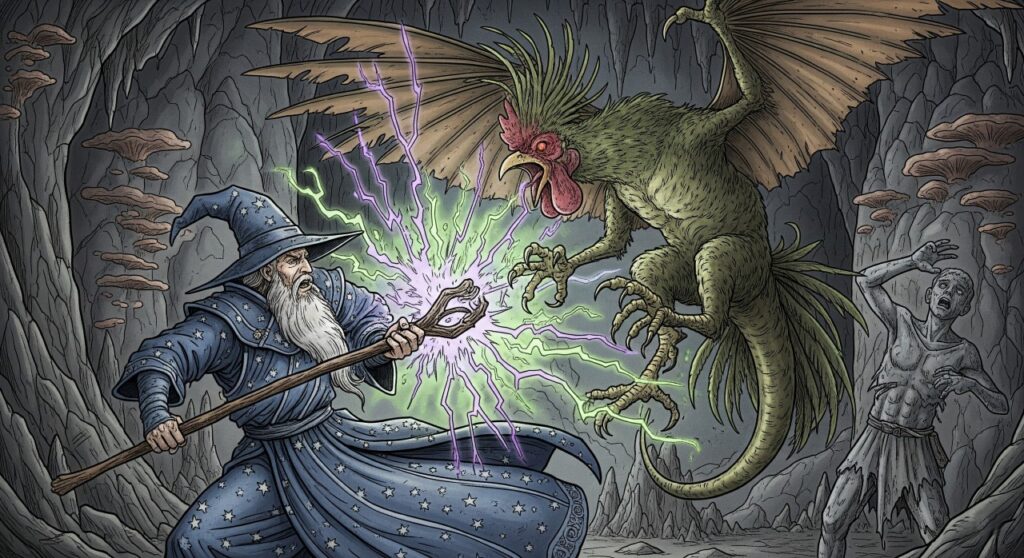
The final main chapter delivers a comprehensive bestiary with dozens of adversaries across a wide range of types and difficulty levels. Each stat block is presented in the system’s clean, compact style—easy to read and quick to run during play.
Adversaries are grouped thematically, and include:
- Animals and Beasts: Giant eagles, wolves, serpents
- Undead: Skeletal guardians, banshees, corpse collectors
- Fey and Spirits: Mischievous or malevolent magical beings
- Humanoids: Bandits, rival adventurers, cultists
- Weird Creatures: Living slime, cursed constructs, elemental oddities
Each stat block includes:
- Core stats and traits
- Special actions or afflictions
- Difficulty classification (based on enemy level, not challenge rating)
The adversaries are varied not just in power but in theme. Some are straight-up threats, while others could be allies, patrons, or rivals. Many are weird in the best way—reflecting the game’s balance of charm and strangeness.
📊 Appendix: Enemy Difficulty Index
This concluding appendix lists every monster by name, level, and difficulty band. It’s a small but vital usability feature, allowing GMs to quickly find enemies appropriate for a given party.
🧾 Final Verdict
Secrets of the Weird Wizard is not the kind of supplement that expands character options or reinvents core systems. Instead, it does something arguably more valuable: it expands the game’s world and supports the GM directly.
The Borderlands region is a standout—a well-structured, table-ready sandbox full of flavor and freedom. The bestiary is deep, diverse, and easy to use. And the Sage Advice section ensures that GMs approach the material with the right mindset: narrative first, rules-light, and fun-focused.
If you’re running or planning to run Shadow of the Weird Wizard, this book is a must-have. If you’re just playing, you’ll find less to use directly—but your GM absolutely should own it.