Monte Cook’s City by the Spire
When Monte Cook originally released Ptolus: City by the Spire in 2006, it was more than just a campaign setting—it was a statement. Billed as “a campaign setting like no other,” Ptolus wasn’t just a book. It was an artifact, a massive, 672-page tome filled with detailed lore, lavish art, and a structure that seamlessly supported both storytelling and gameplay. Fast forward to its updated release in 2021 for D&D 5E and Cypher System, and Ptolus remains one of the most ambitious and comprehensive city settings ever created for tabletop roleplaying games.
This is not a setting you merely use. Ptolus is a setting you inhabit. If you’re a Game Master (GM) who dreams of running a sprawling urban campaign grounded in depth, consistency, and vertical storytelling, Ptolus delivers on nearly every front.
🌆 The Setting: A City of Layers
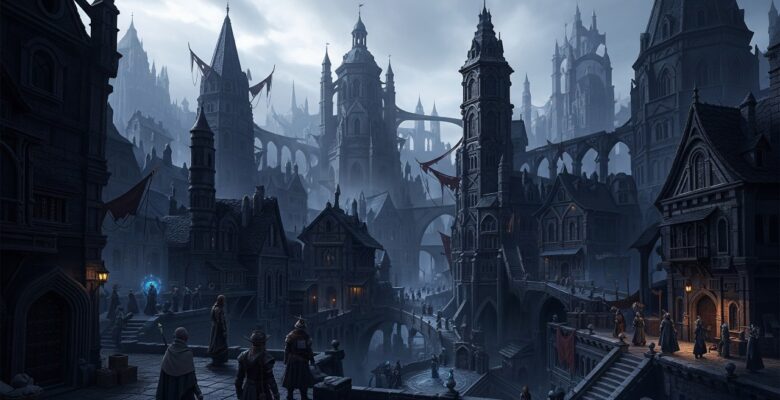
Ptolus is set in Monte Cook’s own world of Praemal, a place where science, magic, religion, and technology coexist—sometimes uneasily. The city itself is built in the shadow of a towering spire, atop ancient ruins that hint at civilizations and horrors long past. This verticality—surface, underground, and sky—is one of Ptolus’s defining traits.
The setting is a blend of high fantasy, dungeonpunk, and gothic noir. Think Waterdeep meets Planescape by way of Eberron. There are steam-powered machines, dark cults, divine emissaries, and interplanar portals—and they’re all baked directly into the city’s lore. At every turn, there’s mystery, danger, or intrigue just waiting for your players to discover.
Rather than being a generic urban setting, Ptolus is tailored to the idea of an ongoing campaign—an “adventure-friendly” city where plot hooks are ubiquitous, factions constantly vie for power, and dungeons are literally beneath your feet.
📖 What’s in the Book?
At over 600 pages (closer to 800 if you include handouts and appendices), the book is a monument to dense, intentional design. Here’s a breakdown of what it includes:
- A complete city guide with over 15 districts, each with their own feel, power players, and secrets
- Hundreds of NPCs—many fully statted—with detailed motivations, affiliations, and ties to others
- Adventure hooks in every section, often tied to specific locations, characters, or historical events
- Deep faction play, including rival churches, noble houses, criminal underworlds, and arcane organizations
- Dozens of dungeons built into the setting’s undercity, catacombs, and ancient ruins
- Full support for both D&D 5E and Cypher System, including system-specific stat blocks and mechanics
One of the key innovations of Ptolus is the use of sidebars and marginalia throughout the text. These offer GM tips, adventure seeds, reminders, and rules suggestions right next to the relevant content, drastically reducing page-flipping during prep.
✒️ Tone and Style
Unlike many settings that focus on world-scale political machinations or broad cosmology, Ptolus is personal. It wants you to build stories where characters grow and become part of the city’s living pulse. The tone invites storytelling grounded in character interaction, moral ambiguity, and exploration of a city where magic isn’t rare—it’s institutionalized.
Importantly, Ptolus doesn’t tell stories for you—it lays the groundwork. The narrative structure is open-ended, with dozens of plot arcs, mysteries, and timelines you can weave together or ignore entirely.
🎲 Gameplay Integration
One of the standout aspects of Ptolus is how well it balances narrative depth with playability. It’s not a setting you’ll read once and shelve—it’s designed for ongoing campaign use. This is helped by several smart design choices:
- Clear cross-referencing between locations, NPCs, and storylines
- Dedicated sections for running city-based campaigns
- In-world handouts, including broadsheets (newspapers), maps, and documents
- Practical GM tools, like tables of NPC names, shops, and events
The dual system support (D&D 5E and Cypher System) is also unusually complete. Instead of tacked-on conversions, each system’s mechanics feel purpose-built for the setting. If you’re running 5E, you get full stat blocks, item mechanics, and spell rules. If you prefer Cypher, the tone fits even better, often leaning into narrative flexibility and player-driven drama.
📚 Production Value
The production quality of Ptolus is, in a word, exceptional. The book is printed in full color with sturdy binding, glossy pages, and hundreds of illustrations and maps. The layout is clean, intuitive, and packed with user-friendly features. The digital PDF version is fully bookmarked and hyperlinked, making it easy to navigate a setting of this size.
The boxed set edition—available through Monte Cook Games—includes handouts, maps, and reference sheets that enhance the at-table experience. It’s a premium product, and it feels like one.
✅ Strengths
- Incredible depth and detail: Ptolus is rich with lore, factions, characters, and plotlines
- Adventure-ready design: The book constantly gives you reasons to run stories, not just read lore
- Vertical structure: Undercity dungeons, Spire-top towers, and street-level action offer a layered world
- Presentation and usability: Sidebars, cross-references, and player aids make running the city a joy
- Dual system support: Seamless integration with both 5E and Cypher rulesets
⚠️ Weaknesses
- Size and complexity: The sheer amount of content can be overwhelming, especially for new GMs
- Prep time: Despite its usability, you’ll still need time to absorb and plan from such a massive sourcebook
- Less ideal for sandbox play: While open-ended, Ptolus thrives when GMs use its structured factions and plots
- Cost: The premium book and boxed sets are priced accordingly—worth it, but a barrier for some
🧭 Final Verdict
Ptolus isn’t just a campaign setting—it’s a GM’s toolbox, player playground, and narrative engine all in one. With unmatched depth, thoughtful design, and an immersive, vertical setting, it stands as one of the most impressive TTRPG supplements ever published.
If you’re looking to run a city-based campaign where every street corner hides a secret and every NPC could be the key to your next story arc, Ptolus is the gold standard. It demands an investment of time, attention, and prep—but it repays that investment with some of the richest roleplaying opportunities available in modern TTRPGs.