
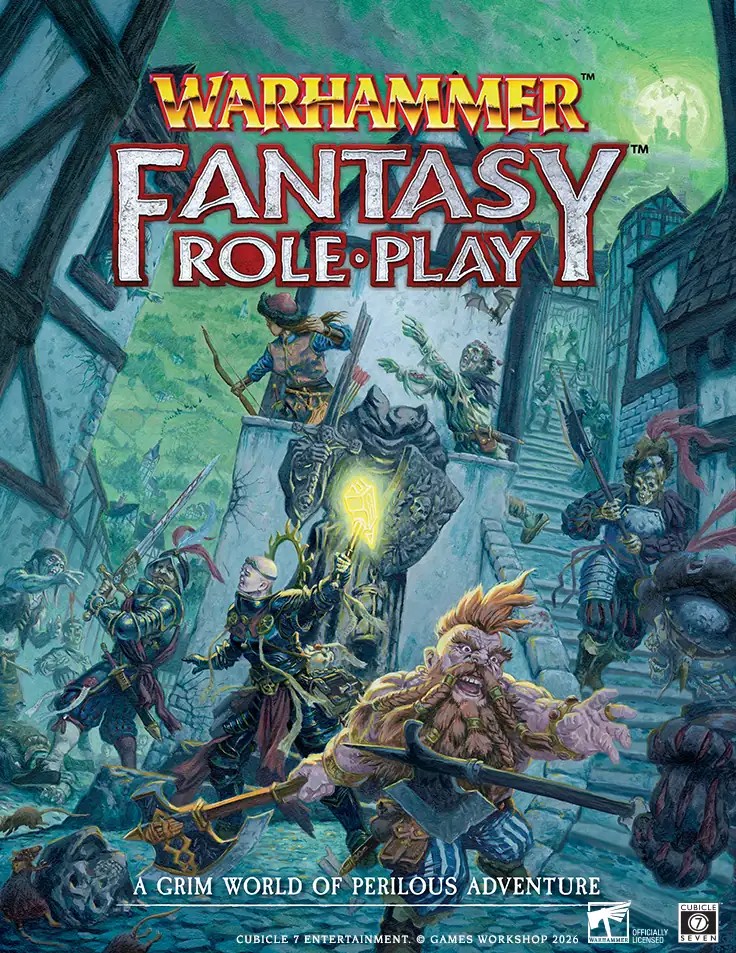
Warhammer Fantasy Roleplay Fifth Edition (WFRP 5E) marks an important milestone for one of tabletop roleplaying’s most recognizable dark fantasy franchises. Published by Cubicle 7 Entertainment under license from Games Workshop, the fifth edition celebrates the game’s 40-year legacy while modernizing the rules for a new generation of players.
Rather than completely reinventing the system, Cubicle 7 has taken an evolutionary approach, building upon the foundation established by Fourth Edition. The development team, led by Dominic McDowall and Dave Allen, spent considerable time refining the existing mechanics, incorporating years of player feedback, and addressing areas where the previous edition could become unnecessarily complicated. The result is a more streamlined version of the familiar game that retains much of its original depth and character.
One of the most welcome design decisions is the commitment to backward compatibility. Cubicle 7 specifically designed Fifth Edition so that much of the existing Fourth Edition library—including adventures, campaigns, and setting supplements—can continue to be used. This is particularly valuable for established groups that have invested heavily in the previous edition and want to transition without abandoning their existing collections.
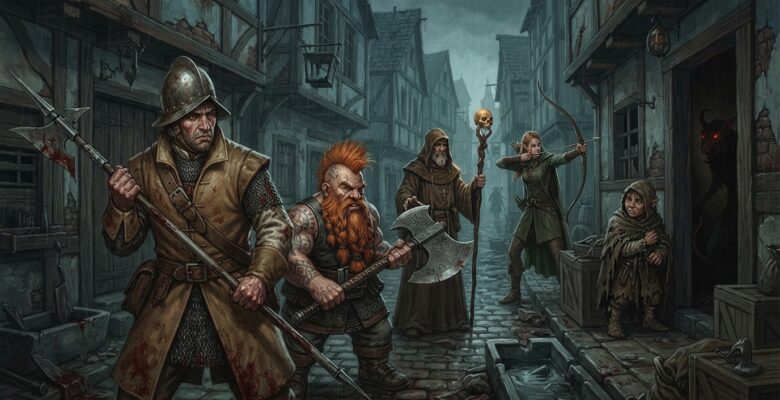
At its heart, WFRP remains a game about ordinary people struggling to survive in an extraordinarily dangerous world. Players aren’t necessarily legendary warriors or powerful spellcasters. They are adventurers, investigators, mercenaries, priests, craftsmen, and other inhabitants of a world where corruption, political intrigue, disease, superstition, and Chaos are constant threats.
For groups seeking a fantasy RPG that emphasizes atmosphere, character development, investigation, and genuinely dangerous adventures, Fifth Edition offers an appealing combination of traditional roleplaying depth and modern refinements.
📖 What’s Inside — Core Rulebook Contents
The Fifth Edition Core Rulebook provides the essential material needed to create characters, run adventures, and explore the Old World. Its contents cover both player-facing mechanics and the resources required by Game Masters.
Among its principal features are:
- Five character types: Humans, Dwarfs, Halflings, Wood Elves, and High Elves.
- 64 distinct careers: Representing the professions, social positions, and lifestyles that define characters.
- Skills and talents: Providing mechanical differentiation and opportunities for character development.
- Religion and miracles: Rules covering the major religious traditions and the supernatural abilities of their priests.
- Multiple magical traditions: Giving spellcasters access to different approaches to magic.
- Combat and pursuit rules: Revised mechanics for dangerous confrontations and chases.
- Diseases and other hazards: Supporting the setting’s emphasis on physical vulnerability.
- Game Master guidance: Advice for creating and managing adventures.
- A bestiary: A collection of creatures and adversaries suitable for Old World campaigns.
These features give the rulebook considerable breadth. Instead of requiring players to immediately purchase several supplements to access the basic character options, religious material, and magical systems, the core volume brings the principal elements together.
The inclusion of 64 careers is particularly important. Careers are central to WFRP’s identity, providing characters with a profession and social identity beyond their adventuring activities. A character’s background influences how they interact with the world, what opportunities are available, and how they develop over time.
This helps distinguish WFRP from fantasy RPGs where character identity is primarily defined by combat class and supernatural abilities.
🎲 Core Mechanics — Refining the Familiar
Fifth Edition retains the recognizable percentile-based approach associated with Warhammer Fantasy Roleplay. The system continues to emphasize skills, characteristics, and the uncertainty of attempting difficult tasks in a dangerous environment.
For returning players, this means the fundamental experience remains familiar. The game has not abandoned its traditional mechanical identity in favor of an entirely different dice system.
However, Cubicle 7 has made several meaningful adjustments.
⚙️ Streamlined Rules
One of the development team’s primary goals was reducing unnecessary complexity without sacrificing the mechanical depth that distinguishes Warhammer Fantasy 5E.
According to the designers, certain special-case rules have been reduced or removed where their mechanical impact did not justify the additional bookkeeping.
Talents have also been refined so that they apply to more specific areas, reducing overlapping bonuses and making their effects easier to understand.
These adjustments are important because Fourth Edition could occasionally become cumbersome when multiple modifiers, special abilities, and situational rules interacted.
Fifth Edition attempts to preserve meaningful character customization while making those interactions easier to manage.
⚔️ Revised Combat
Combat has received particular attention.
WFRP has never been intended to portray adventurers as invincible fantasy superheroes. A fight against even relatively ordinary opponents can have serious consequences, and injuries can permanently change a character’s circumstances.
Fifth Edition continues this philosophy while revising combat to flow more smoothly and become easier to track.
The designers have also deliberately made combat more dangerous by reducing the number of ways characters can deflect critical hits.
This is an important distinction. Rather than making characters increasingly resilient as they advance, the system maintains the possibility that even experienced adventurers can suffer devastating injuries when circumstances turn against them.
For players who enjoy tactical decision-making but appreciate the consequences of taking unnecessary risks, this approach is particularly appealing.
🏰 The Old World — A Setting Unlike Traditional High Fantasy
The setting remains one of WFRP’s greatest strengths.
The Old World is a grim, dangerous interpretation of traditional fantasy, where civilization struggles to survive against supernatural horrors, political corruption, religious fanaticism, and the ever-present influence of Chaos.
The Empire is the primary backdrop for many campaigns. Its great cities, including Altdorf, Middenheim, and Nuln, offer opportunities for trade, intrigue, exploration, and adventure. However, these settlements are hardly safe havens. Criminal organizations, corrupt officials, secret cults, and competing political interests create dangers that can be just as threatening as the monsters lurking beyond the city walls.
Outside civilization, the landscape becomes increasingly hostile. Goblins infest the forests, Beastmen prey upon travelers, and the corrupting influence of Chaos threatens to transform ordinary people into horrifying creatures.
This combination of urban intrigue and wilderness danger gives Game Masters considerable flexibility. A campaign might involve investigating a suspicious merchant, uncovering a conspiracy within a religious institution, escorting a caravan through dangerous territory, or confronting a supernatural threat threatening an entire settlement.
Importantly, the setting doesn’t require every adventure to revolve around defeating a powerful villain. Some of the most memorable WFRP experiences come from relatively ordinary characters becoming entangled in situations far beyond their capabilities.
That sense of vulnerability is fundamental to the game’s identity.
🧙 Religion & Magic
Religion and magic receive substantial attention in the Fifth Edition Core Rulebook.
The religious material explores the major faiths of the Old World and provides rules for the miracles performed by their priests. Faith is an important part of everyday life in the Empire, influencing social customs, political institutions, personal morality, and attitudes toward supernatural threats.
Priests are therefore more than ordinary spellcasters with different terminology. Their abilities and responsibilities connect them directly to the religious and cultural institutions of the setting.
Magic is similarly important, although it is rarely portrayed as entirely safe or predictable. The rulebook incorporates material informed by the earlier Winds of Magic supplement, integrating multiple magical traditions more closely into the core experience.
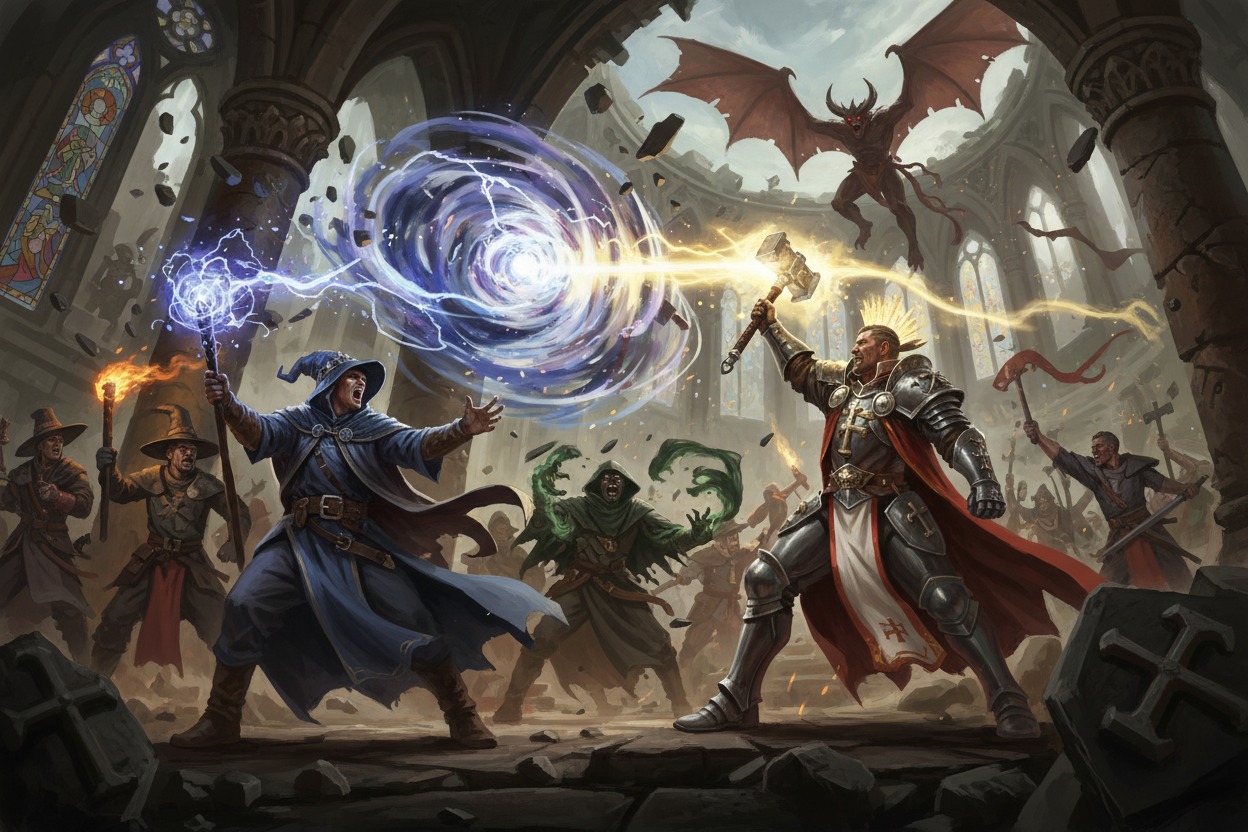
This is a welcome development because magic in Warhammer has always been a dangerous undertaking. Its practitioners possess extraordinary abilities, but their power comes with considerable risks and social complications.
The expanded integration of magical material should also make it easier for Game Masters to incorporate spellcasters into campaigns without relying as heavily on additional reference books.
🧑🌾 Character Development & Careers
Character creation remains one of the defining features of WFRP.
The five available character types provide a familiar foundation, but the 64 careers are where the system really distinguishes itself.
Rather than restricting characters to conventional fantasy archetypes, careers represent a broad range of occupations and social positions. This creates opportunities for characters whose abilities and backgrounds reflect the everyday realities of the Old World.
A party might include a soldier, a physician, a merchant, a priest, and a less reputable individual whose previous occupation creates interesting complications.
Such diversity makes the game particularly suitable for campaigns involving investigation, political intrigue, exploration, and social interaction.
The career system also reinforces the idea that characters have lives outside adventuring. Their professions provide context for their motivations, relationships, and aspirations.
This is an important part of what makes WFRP feel different from more combat-oriented fantasy RPGs.
🎭 Game Master Support & Campaign Potential
The Core Rulebook includes dedicated Game Master guidance, a bestiary, and the rules necessary to manage the many hazards characters encounter.
The revised mechanics should also make campaign management more comfortable, particularly for Game Masters who found Fourth Edition’s numerous special-case rules difficult to track.
The backward-compatibility commitment is especially significant here. Cubicle 7 has spent years building an extensive WFRP library, including adventures, campaigns, regional guides, and specialized character supplements.
Being able to continue using much of this material means Fifth Edition benefits from an established catalogue rather than starting from scratch.
For established groups, this makes the transition considerably less disruptive. For newcomers, it provides access to a substantial ecosystem of published adventures and setting material.
🎨 Presentation & Production
Cubicle 7 has maintained the distinctive visual identity associated with modern Warhammer publications.
The game’s presentation supports its grim fantasy atmosphere, combining detailed illustrations, evocative setting material, and practical rules organization.
The publisher’s commitment to the 40th anniversary also gives the edition an appropriate sense of occasion. Rather than presenting Fifth Edition as a completely new direction, the book celebrates the history of the franchise while providing a refined foundation for future campaigns.
The inclusion of the familiar Old World races, careers, religions, and magical traditions helps preserve the visual and thematic continuity that longtime fans expect.
The overall approach should appeal to both veteran WFRP players and newcomers interested in exploring one of fantasy roleplaying’s most distinctive settings.
⭐ Strengths — What Fifth Edition Does Well
⚔️ Improved Accessibility
The effort to simplify special-case rules, clarify talents, and streamline combat makes the game more approachable without abandoning its mechanical depth.
📚 Excellent Career Variety
Sixty-four careers provide considerable character-building flexibility and reinforce the importance of social identity and occupation.
🏰 Outstanding Setting
The Old World remains one of the richest fantasy environments available for tabletop roleplaying, offering an excellent balance of political intrigue, investigation, horror, and traditional adventure.
🔄 Backward Compatibility
The ability to continue using much of the Fourth Edition catalogue is a major advantage for existing players and Game Masters.
🧙 Integrated Magic & Religion
Bringing multiple magical traditions and religious material into the core rulebook provides a more complete foundation for character creation and campaign development.
💀 Dangerous Combat
The decision to make combat more dangerous reinforces the setting’s grim atmosphere and ensures that confrontations remain meaningful.
⚠️ Considerations & Potential Drawbacks
Despite its improvements, Fifth Edition isn’t necessarily the right choice for every group.
Existing Fourth Edition Owners: The new edition is an evolution rather than a complete redesign. Groups already comfortable with Fourth Edition may find the improvements worthwhile but not essential enough to justify replacing their existing core rulebooks.
Mechanical Complexity: Although streamlined, WFRP remains a relatively detailed percentile-based RPG. Players looking for extremely lightweight rules or fast, cinematic combat may prefer a simpler alternative.
Grim Fantasy Themes: The setting regularly explores corruption, disease, violence, religious fanaticism, and other mature subjects. Its tone may not appeal to groups seeking traditional heroic fantasy.
Combat Lethality: The emphasis on dangerous combat means characters can suffer serious consequences. Players accustomed to heroic fantasy protagonists who routinely overcome overwhelming odds may need to adjust their expectations.
Transitioning Existing Material: Backward compatibility is a significant benefit, but it should not be interpreted as meaning every Fourth Edition rule or supplement will transfer without adjustment. Game Masters should be prepared to make occasional conversions.
🏆 Final Verdict
Warhammer Fantasy Roleplay Fifth Edition is a thoughtful and welcome evolution of one of tabletop roleplaying’s most enduring fantasy franchises. Rather than attempting to reinvent the game, Cubicle 7 has concentrated on improving the existing experience through clearer rules, streamlined combat, refined character abilities, and better integration of important systems.
The decision to preserve backward compatibility is arguably its most important feature. Players who have invested in Fourth Edition can retain much of their existing material, while newcomers receive a comprehensive rulebook that brings together character creation, careers, magic, religion, combat, and Game Master resources.
The game’s greatest strength remains its setting. The Old World provides an exceptional backdrop for campaigns that combine investigation, political intrigue, dangerous exploration, and supernatural horror. Its career system encourages memorable characters who feel like actual inhabitants of the world rather than conventional fantasy adventurers.
Although the changes may not be substantial enough to convince every Fourth Edition veteran to upgrade, the refinements make Fifth Edition an attractive starting point for new players and a worthwhile consideration for established groups.
Recommended For: Fans of grimdark fantasy, investigative campaigns, detailed character development, dangerous combat, and players who enjoy the Warhammer universe.
Less Suitable For: Groups seeking lightweight mechanics, high-powered heroic fantasy, or combat encounters where characters face little risk of serious injury.
Overall Assessment: Warhammer Fantasy Roleplay Fifth Edition successfully modernizes a classic without losing what made it special. It is an excellent foundation for exploring the Old World and continuing the legacy of grim and perilous adventure.