
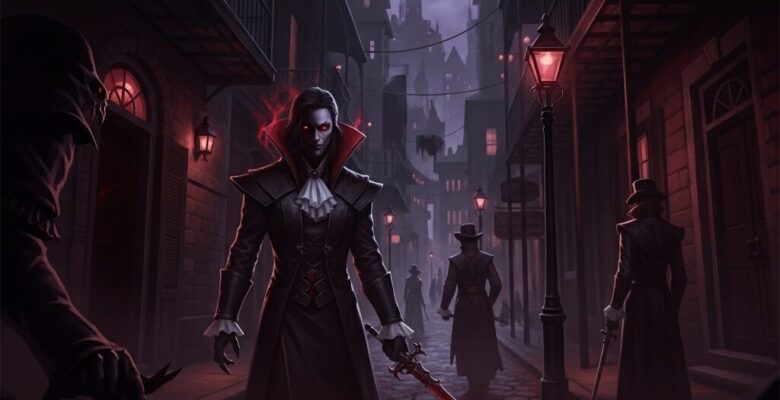
Originally launched in 1991, Vampire: The Masquerade introduced players to the World of Darkness—a modern gothic-punk setting where players embody the undead navigating a fragile balance of power, identity, and morality. With its emphasis on personal horror, moral ambiguity, and political intrigue, it became a cornerstone of narrative-driven tabletop RPGs.
Fifth Edition (V5), published in 2018 by White Wolf and later developed by Modiphius and Renegade Game Studios, represents a major evolution. It refines the system, updates the lore to reflect 21st-century themes, and doubles down on the series’ central themes: humanity, addiction, secrecy, and the price of immortality.
V5 isn’t a nostalgia trip—it’s a bold reimagining designed for both new and returning players.
Tone and Themes
V5 leans fully into the “personal horror” ethos. Being a vampire isn’t just a supernatural power fantasy; it’s a curse—a nightly struggle to maintain control over your monstrous instincts, avoid persecution, and retain some shred of your former humanity.
The world is darker and more realistic than ever. Governments are aware of vampires, the global Camarilla network is fractured, and the Second Inquisition—a loose alliance of intelligence agencies and religious hunters—is actively purging Kindred (vampires) from major cities.
The modern setting blends:
- Surveillance-state paranoia (cell phones and social media are liabilities),
- Real-world politics (refugee crises, police overreach, corporate fascism),
- Vampiric intrigue, with centuries-old power struggles festering under neon-lit nights.
It’s elegant, uncomfortable, and unapologetically adult.
Core Mechanics
V5 retains the Storyteller System, with some significant revisions.
🎲 Dice Pools
- Players roll pools of d10s, based on an Attribute + Skill combo.
- Successes are determined by counting how many dice show 6 or higher.
- Difficulty is the number of successes required.
- Criticals occur when two 10s are rolled—especially potent when using Hunger dice (more on those below).
🩸 Hunger Mechanic
A defining innovation of V5, the Hunger mechanic represents your character’s thirst for blood.
- Instead of tracking blood points, players gain Hunger dice (red d10s).
- The more hungry you are, the more red dice you roll instead of normal ones.
- Rolling a 1 on a Hunger die can trigger Bestial Failures (lose control) or Messy Criticals (succeed violently or with complications).
This simple system elegantly enforces the predator-vs-human tension that’s core to the setting. Feeding isn’t optional—it’s survival.
⚖️ Stains and Humanity
Rather than tracking “Humanity” as a simple descending number, V5 introduces a Stains system. When you commit actions that conflict with your character’s moral code (Chronicle Tenets), you accrue Stains. At the end of the session, a Remorse check determines whether you feel guilt—or slip further into apathy.
This system brings personal ethics and roleplaying to the forefront. Every player’s sense of morality matters, and the decline toward monstrosity is a slow, nuanced slope.
Clans and Disciplines
V5 includes several of the core 13 vampire clans, each with unique Disciplines (powers), Banes (curses), and identities.
The core book includes:
- Camarilla staples like Ventrue (aristocrats), Toreador (artists), Brujah (rebels), Malkavian (oracles), Nosferatu (information brokers), Gangrel (beasts), and Tremere (blood sorcerers).
- Thin-bloods, a weakened new generation of vampires with unstable powers and uncertain place in society.
Later supplements reintroduce:
- The Banu Haqim, Lasombra, and Ravnos, among others.
- The Anarch Movement and Cults of the Blood Gods—providing ideological and spiritual alternatives to the Camarilla.
🧪 Disciplines
V5 disciplines are streamlined, each offering level-based powers (dots from 1–5). Players can freely use lower-tier powers they’ve unlocked, though some require rouses (risking hunger).
Example Disciplines:
- Celerity – Supernatural speed
- Potence – Brutal strength
- Dominate – Mind control
- Obfuscate – Invisibility and deception
- Blood Sorcery – Ritualistic magic
The system avoids “power creep” and encourages thoughtful, story-relevant use of abilities.
Character Creation
Characters are defined by:
- Clan (bloodline)
- Attributes (e.g., Strength, Wits, Resolve)
- Skills (e.g., Persuasion, Larceny, Stealth)
- Predator Type – how your vampire feeds (e.g., alleycat, consensualist, scene queen)
- Convictions & Chronicle Tenets – your personal and shared moral codes
- Ambition and Desire – your character’s long-term and short-term goals
- Touchstones – mortals who anchor your humanity
This framework encourages deep, narrative-first character creation. Even a combat-heavy vampire has emotional anchors, inner conflict, and ethical dilemmas to explore.
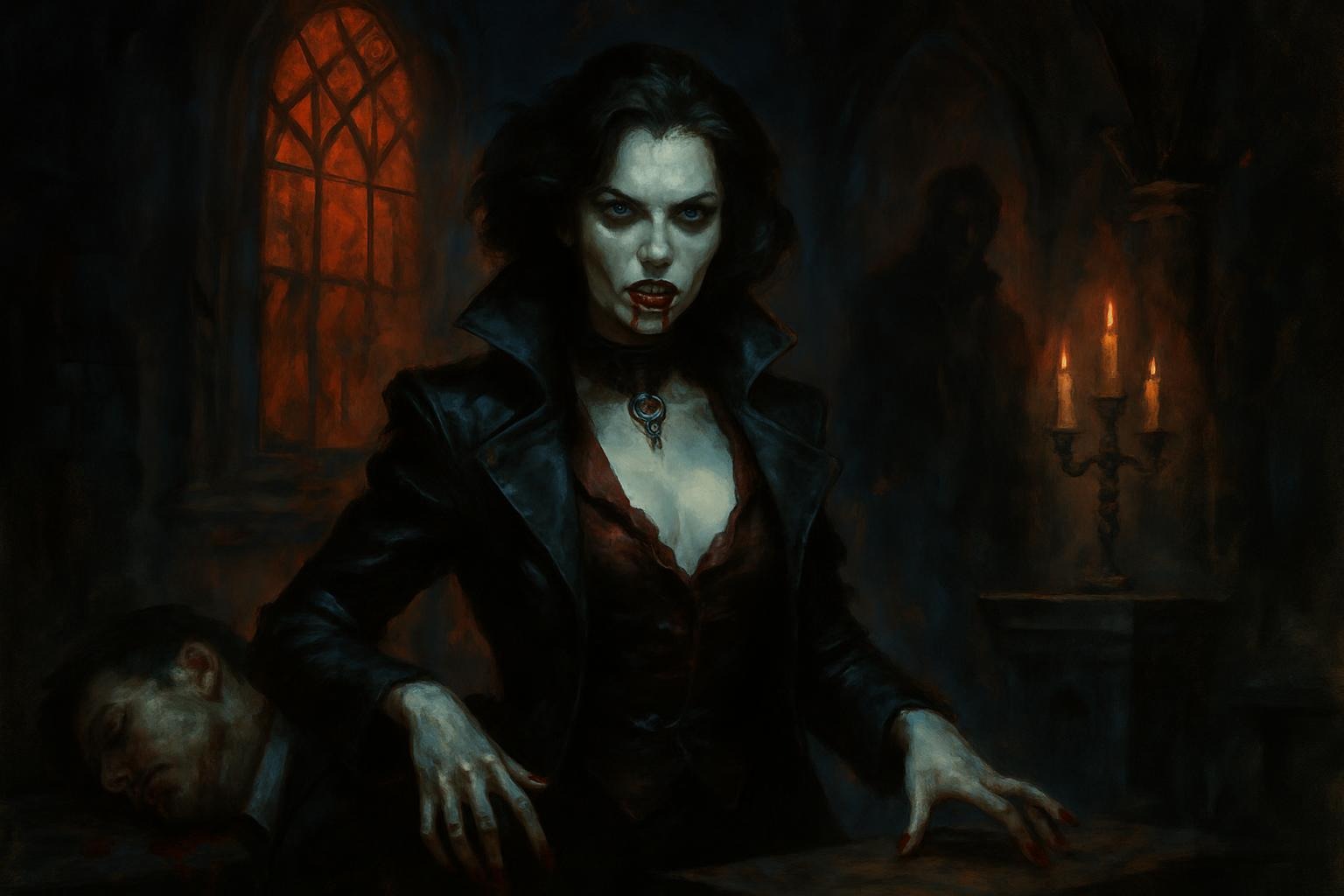
The World of Darkness Today
V5 updates its setting to modern times. Key changes include:
🧨 The Second Inquisition
Global intelligence agencies and religious operatives now hunt vampires using cutting-edge tech, satellites, and information warfare. Being careless with your phone or feeding in public can doom an entire coterie.
🕵️ The Beckoning
Older vampires (6th gen or lower) are being mystically called to the Middle East, removing them from their power bases. This creates a power vacuum, giving player characters a chance to rise.
🔥 The Anarch Movement
The Anarchs are no longer comic-relief rebels—they are a legitimate political faction fighting authoritarianism and inequality. Often younger, more diverse, and more ideologically motivated than the Camarilla.
Strengths
✅ Thematic Depth
V5 returns the game’s focus to intimacy, power, and morality. Feeding is a risk, the Beast is always near, and every action has emotional weight.
✅ Modernized Mechanics
The Hunger and Stains systems are elegant, engaging, and reinforce the fiction. The shift to narrative-focused XP and character growth encourages meaningful storytelling over combat optimization.
✅ Visual Design
V5’s layout is sleek, with bold typography, moody photography, and immersive sidebars. It feels like a modern rulebook for a game of dark secrets.
✅ Strong Narrative Support
The Chronicle Tenets, Touchstones, and Remorse mechanics give players concrete tools to roleplay moral conflict. Every vampire is different—not just in powers, but in what they’re willing to do.
Weaknesses
❌ Mature Themes
V5 deals with addiction, manipulation, trauma, abuse, and political violence. While the rulebook stresses safety tools (e.g., Lines and Veils, consent mechanics), GMs must be prepared to facilitate adult content responsibly.
❌ Lore Gaps & Fragmentation
Not all clans or factions are included in the core book; you’ll need supplements for full access to legacy content. Some older fans were alienated by the narrative shift away from the deep metaplot.
❌ Controversial Past
Early V5 development had controversies related to the portrayal of real-world political issues (e.g., Chechnya). White Wolf was restructured and later absorbed by Paradox/Renegade, which has since steered the line toward safer, better-curated material.
Conclusion
Vampire: The Masquerade 5th Edition is a haunting, elegant, and thoughtfully modern evolution of a classic RPG. It honors the legacy of the original while addressing the needs of today’s players—with a refined system, immersive setting, and bold narrative tools.
Whether you’re exploring neon-drenched Chicago, fighting for anarch revolution, or trying to protect your mortal Touchstones from your own hunger, V5 offers one of the most emotionally rich, narratively rewarding experiences in tabletop gaming.