
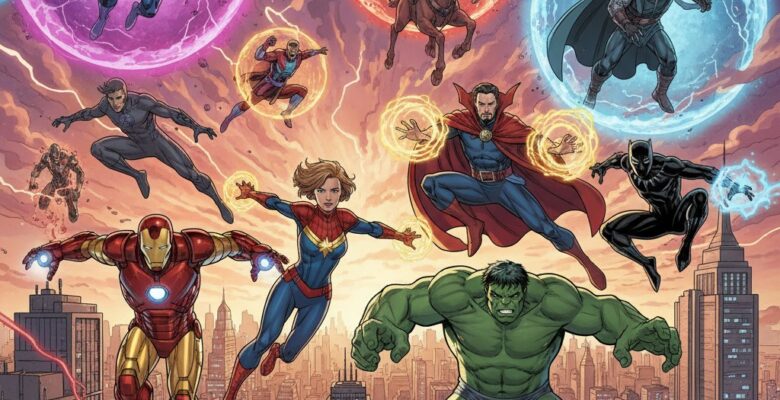
Marvel Multiverse RPG is Marvel’s newest official tabletop role-playing game, released in August 2023 with the Core Rulebook by Marvel (written by Matt Forbeck). It introduces the d616 System, sometimes called “All-New, All-Different d616,” as its resolution mechanic. The game lets you play as canonical Marvel heroes & villains or create your own custom heroes, exploring the Marvel multiverse. The book is in hardcover and digital formats; it’s sold through major retailers, online stores, and virtual tabletops (Roll20, Demiplane) among others.
🎲 Core Mechanics & System
- d616 System: The core resolution mechanic uses three six-sided dice (3d6), one of which is the Marvel die (recognized via a logo or a uniquely colored die). You roll 3d6 + relevant Ability Score, attempting to beat a Target Number derived from character Rank and Difficulty. The Marvel die counts as a six in almost all cases, except in one special failure case (if the other two dice are ones).
- Target Numbers, Rank, and Difficulty: The system defines discrete Ranks (Rank 1 up to Rank 6) as imposed power levels for characters. Rank influences default capabilities (health, damage, defenses). Difficulty levels are adjectives (Trivial, Easy, Routine, Challenging, Difficult, etc.) that modify the required roll.
- Powers & Thematic Options: Every character has powers. There are large power lists organized thematically (archetype inspirations), allowing a wide breadth of super-powers and options. The Core Rulebook also includes full profiles for familiar Marvel heroes & villains.
🧩 Character Creation & Advancement
- Building your hero or villain: Players can use Marvel’s iconic characters’ profiles or build entirely original ones. Character creation includes selecting Abilities, Rank, Powers, and origin stories. The “quick character creation” rules ease entry for new players.
- Rank Progression: Characters start at Rank 1 and can advance up to Rank 6. Advancement gives improved stats, new powers, and higher thresholds. Unlike many RPGs, Rank differences matter a lot for power scaling; Rank also ties into damage, defense, etc. However, per reviewer feedback, characters in many campaigns may only rank up a few times over long play, so much of the expected growth is front-loaded.
- Balancing and Customization: Marvel removed earlier restrictions from the playtest, for example many power sets were previously locked to Archetypes; in the final Core Rulebook, those restrictions have been lifted to allow more freedom in building. Combat modifiers tables and heavy overhead from the playtest have been simplified.
⚔️ Gameplay Flow & Combat
- Dice Rolls & Success: Both combat and non-combat actions, per the system, resolve via a single roll of 3d6 + ability vs. target number modified by difficulty and rank. This avoids needing separate damage rolls vs hit rolls etc.
- Edge and Trouble: These mechanics allow certain rerolls or penalties depending on narrative context; Edge gives a chance for a more favorable result, Trouble allows the Narrator to force a more challenging result. These help add drama.
- Abilities & Power Themes: Abilities include standard superhero-style stats (like Might, Agility, Resilience, Vigilance, Ego, Logic) and powers are grouped, but many mechanics require flipping through the book to fully understand how individual powers interact. Some reviewers found power selection and reference more cumbersome than ideal.
🌟 Presentation, Content & Expansions
- Hero & Villain Profiles: The Core Rulebook includes dozens of Marvel characters (e.g. Spider-Man, Captain America, Wolverine) with their full stat blocks. This helps players jump in with familiar faces.
- Powers Diversity & Thematic Arcs: There are many power options and themes in the power chapter. While the review consensus is that breadth is good, the depth and clarity of each power varies—some are unquestionably powerful, others less clearly defined.
- Accessibility & Extras: The game offers digital tool support on Roll20, Demiplane; quick-start guides; art, splash pages by Marvel artists; accessories (heroic dice set) etc. The extras help players and Narrators.
⚠ Strengths & Weaknesses
Strengths:
- Marvel lore & thematic pull. If you love Marvel, the pull of jumping into canonical heroes, seeing their stats, getting Marvel-verse content is strong.
- Systems updated from playtest. The simplification (e.g. reducing complexity of modifiers, removing some locked power-set restrictions) makes the final system more approachable.
- Narrative & drama potential. Edge/Trouble, rank vs difficulty scaling, powerful powers make cinematic fights possible. It supports superpowered storytelling rather than crunchy tactical simulation.
Weaknesses / Trade-offs:
- Character creation is time-consuming. Because of the depth of powers and thematic variety, building a custom character (especially first time) involves considerable reading, cross-referencing. Some review sources find that off-putting for new players.
- Power balance uneven. Some powers are seen as “break out” strong; others less useful. Rank and damage scaling is frontloaded; by later ranks the relative difference between power levels becomes huge.
- Limited advancement. With only 6 ranks, and feedback that players may not rank up often, some feel character evolution is slower than expected in a superhero game. Power focus tends more on power selection early rather than incremental growth.
🧭 Who Is Marvel Multiverse RPG For?
Best for:
- Marvel fans wanting official, current Marvel lore in tabletop format.
- Gamers who like superhero stories more than tight tactical crunch. If you want cinematic moments, dramatic powers, and storytelling, this will feel rewarding.
- Tables that can invest in the initial character creation, are OK with referencing during play, and will use digital tools or accessories for convenience.
Less ideal if:
- You want fast-build or lightweight systems with minimal rule overhead. Compared to some older or indie supers RPGs, there’s more referencing and complexity up front.
- You emphasize continuous power growth or scaling over many levels. The progression is more limited.
- You want highly balanced optimization or fine-tuned damage / combat comparisons; power selection can become highly divergent.
🗡 Final Verdict
The Marvel Multiverse RPG is a strong addition to the superhero RPG field. It succeeds in offering Marvel fans a rich, modern system, official profiles, and the promise of expansions (X-Men, Spider-Verse, Cataclysm of Kang) to broaden the universe of play. For players and Narrators who love superpowers, dramatic hero/villain dynamics, and jumping into established Marvel lore, it delivers more than enough.
It isn’t perfect — there are trade-offs in power balance, character creation overhead, and progression pacing. But those are the costs of trying to cover a vast IP like Marvel while making rules that both nod to everywhere in the Marvel multiverse and give player agency for originals. If you want a TTRPG to tell Marvel-style stories, with all the trappings, Marvel Multiverse RPG is well worth the investment.