
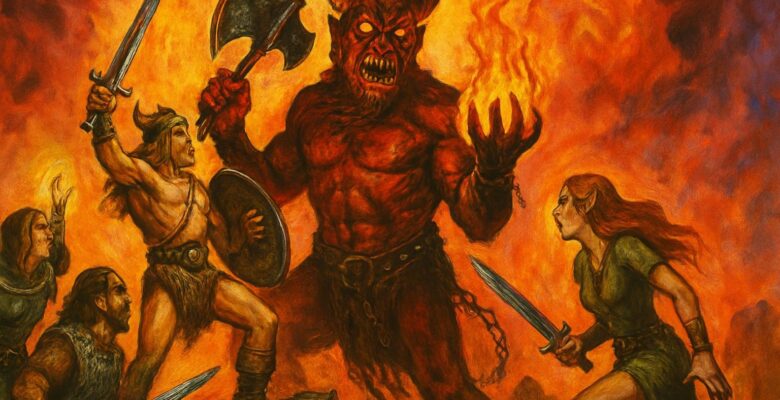
Publisher: Goodman Games
Authors: Joseph Goodman, Harley Stroh, Michael Curtis, et al.
System: Custom D20-based (inspired by 3.5e and old-school design)
Pages: 480
Style: Appendix N / pulp-fantasy revival
Word Count: ~1,600 words
🧭 Introduction: The Weird Revival
Dungeon Crawl Classics RPG (DCC), first published in 2012 by Goodman Games, is more than just another retroclone of early Dungeons & Dragons. It’s a pulpy, metal-infused love letter to the sword-and-sorcery tales of Appendix N—the recommended reading list from Gary Gygax that includes authors like Jack Vance, Michael Moorcock, Fritz Leiber, and Robert E. Howard.
Rather than aim for mechanical fidelity to TSR-era D&D, DCC captures the spirit of old-school play while throwing in its own gonzo flair. It features wild magic, deadly dungeons, mysterious patrons, brutal leveling, and bizarre creatures, all wrapped in dense black-and-white artwork and a system that celebrates the unpredictable.
If you’re tired of balanced encounters, metagaming power curves, or narrative safety nets, DCC’s dangerous and chaotic sandbox might be exactly what your group needs.
📖 What’s in the Book?
The Dungeon Crawl Classics RPG core rulebook is a thick tome—nearly 500 pages of content, including rules, spells, monsters, magic items, and a starting adventure. But don’t let the size fool you: the rules themselves are relatively simple and extremely hackable. Much of the page count is devoted to detailed spell effects, artifacts, and campaign tools.
🔢 Core Mechanics
DCC uses a simplified version of the d20 system. If you’ve played D&D 3rd edition or any OSR system, you’ll recognize the basic framework:
- d20 + modifier vs DC for most checks
- Armor Class instead of THAC0
- Hit points, ability scores, and saving throws
- Classes include Warrior, Cleric, Thief, Wizard, Elf, Dwarf, and Halfling
But this familiar skeleton is layered with innovative mechanics that shift the feel of gameplay dramatically.
⚙️ Key Features
🎲 The Funnel
Perhaps the most iconic feature of DCC is the character funnel. Players start with zero-level characters—often 3 or 4 per player—who are peasants, pig herders, mushroom farmers, and other everyday folk. No class, no powers, just 1d4 HP and a rusty pitchfork.
These disposable characters are then thrown into a deadly adventure, often with gruesome results. The survivors emerge scarred, lucky, and promoted to level 1—where they choose a class and begin their hero’s journey.
This mechanic sets the tone: life is cheap, survival is earned, and fate favors the bold.
🧙 Spellcasting: Vancian and Volatile
DCC magic is where the game truly diverges. Spellcasters don’t simply memorize and cast spells—each spell has a custom chart of wildly varying effects, from fizzles to divine wrath to planar catastrophes.
- Spell checks use a 1d20 roll modified by level, intelligence, luck, and more.
- A single spell (like Magic Missile) can have 20+ possible outcomes based on the check.
- Critical successes might vaporize foes or summon sentient bolts of arcane energy.
- Failure can lead to corruption, patron taint, or deity disapproval.
This dynamic magic system makes spellcasting feel mysterious, dangerous, and fresh every time. Wizards and clerics are true wild cards—forces of arcane or divine chaos rather than reliable utility engines.
⚔️ Mighty Deeds and Luck
Martial characters aren’t left out of the fun. Warriors gain a “Mighty Deed of Arms” mechanic—allowing them to attempt stunts, disarms, shield slams, or other cinematic combat maneuvers by rolling a special deed die alongside their attack.
The Luck stat, meanwhile, plays a huge role in shaping character fate. Players can burn permanent points of Luck to influence rolls, and certain classes (like Thieves and Halflings) regenerate Luck faster or get bonuses from it. This introduces an element of player agency that encourages daring decisions and risk-taking.
📚 Thematic Focus: Pulp, Metal, and Madness
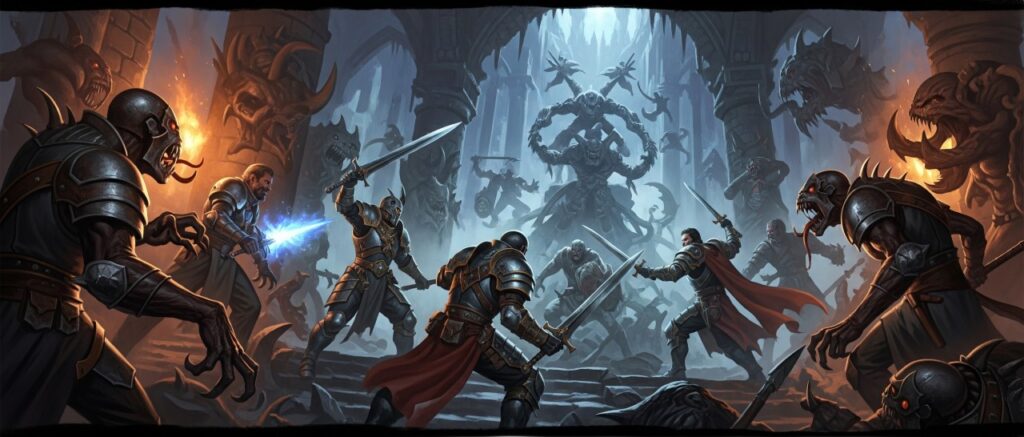
DCC oozes aesthetic. From its iconic black-and-white illustrations by artists like Doug Kovacs and Peter Mullen to the gritty prose of its rulebook, it positions itself not as just a game—but a vibe. Adventures often start in filthy villages and end in ancient alien tombs or towers warped by forgotten gods.
The tone is deadly but humorous, chaotic but heroic. Expect adventures with names like:
- Sailors on the Starless Sea
- The People of the Pit
- Doom of the Savage Kings
- The Queen of Elfland’s Son
This isn’t Tolkien. It’s Lovecraft meets Frazetta.
🎲 Adventures and Modules
Goodman Games has published dozens of excellent DCC modules, many of which are among the best adventure modules available for any system. These adventures are typically short, flavorful, and filled with traps, puzzles, and weird enemies—not just stat blocks and room descriptions.
The default “setting” is deliberately vague, but adventures range from gritty dungeon crawls to planar horror to whimsical fairyland epics. The modularity means DCC can easily be dropped into any homebrew world—or serve as the basis of its own mythos.
📦 Third-Party and Community Content
One of the most impressive aspects of DCC is its flourishing third-party scene. Dozens of publishers (through the “DCC Compatible” license) have released:
- Custom classes (beastmasters, alchemists, sentient fungus, etc.)
- Setting books (Umerica, Hubris, MCC)
- Zines (e.g., Crawl!, Metal Gods of Ur-Hadad)
- Adventure anthologies, spell books, bestiaries, and more
The DCC community is one of the most creative, passionate, and welcoming in the RPG hobby. If the core rules aren’t weird enough for you, the ecosystem will gladly crank the volume.
🖋️ Accessibility and Learning Curve
DCC is not a rules-light game in the minimalist sense. The core book is thick, the spell system is complex, and new players may be overwhelmed by the sheer weirdness.
However, once you embrace the unpredictability, DCC becomes extremely intuitive:
- Rules are built on common d20 expectations
- Player-facing math is simple
- Roleplaying is emphasized over optimization
- The unpredictability keeps veterans engaged
The hardest part is just learning to let go—of control, balance, and long-term planning. DCC is about riding chaos, not taming it.
✅ Strengths
- 🎨 Astonishing Aesthetic – Top-tier illustrations, layout, and tone; every page feels alive
- 🔮 Unpredictable Spellcasting – Magic is a narrative tool, not just a resource pool
- ⚰️ Lethal but Fun – High risk, high reward, high creativity
- 🎲 The Funnel is Genius – Makes early levels exciting and memorable
- 🧠 Player Ingenuity Rewarded – Rules light enough for ruling-on-the-fly, rich enough for tactical play
- 📚 Massive Adventure Library – Goodman Games publishes quality consistently
- 🤝 Community-Driven – Strong third-party and zine culture
⚠️ Weaknesses
- 📘 Core Book Size – Intimidating for new players; should ideally have a player-focused companion
- 🎲 Spell Tables are Heavy – Can slow down gameplay without prep or digital tools
- 🧪 Not for Balance Seekers – If your players want guaranteed fairness, this isn’t the system
- 💻 Limited Digital Support – Though better now, official VTT support has historically lagged behind systems like 5E or PF2E
🧠 Final Verdict
Dungeon Crawl Classics RPG isn’t just another old-school game—it’s a manifesto. It tells players and judges (DMs) alike: embrace the weird, let the dice fall, and tell the kind of stories the ancients dreamed of while staring at velvet Frazetta paintings.
With wild spells, brutal funnels, and one of the most distinctive vibes in the hobby, DCC delivers a style of play that feels fresh, dangerous, and electric. It’s not for everyone—but for those who hear the call of the weird, Dungeon Crawl Classics is a masterwork of modern pulp-fantasy roleplaying.