
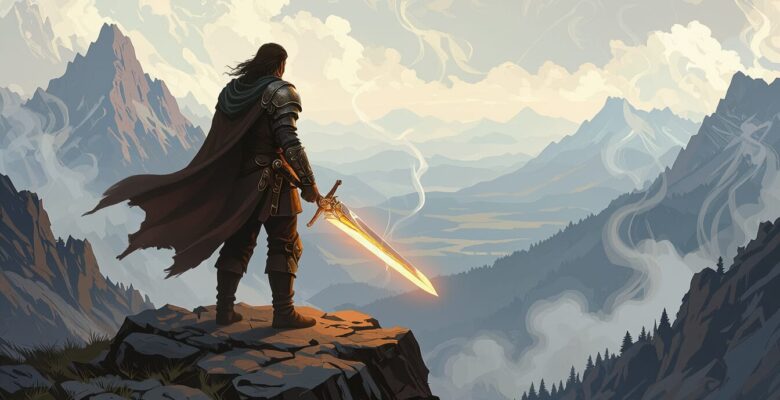
Dungeon World is a fantasy roleplaying game by Sage LaTorra and Adam Koebel, published by Sage Kobold Productions (and later taken over by Burning Wheel Headquarters for print distribution).
It was first released as a PDF in November 2012 and print in 2013. It can currently be found in PDF, paperback, and hardcover editions.
The game uses the Powered by the Apocalypse (PbtA) engine: it combines modern narrative mechanics with “old-school style” fantasy tropes (dungeons, classes, gear, magic) without the mechanical complexity of many traditional D&D variants.
Dungeon World is designed to be collaborative, story-driven, and fiction-first. Character classes, moves, “fronts,” “bonds,” and principles like “ask questions & build your world” help players and GM co-create the setting as the game proceeds.
⚙️ Core Mechanics & System
Here are the key mechanical building blocks of Dungeon World:
- Powered by the Apocalypse / 2d6 + Modifier: When a player attempts a risky or uncertain action (one that triggers a “move”), they roll 2d6 + an ability modifier (Strength, Dexterity, Constitution, Intelligence, Wisdom, Charisma). Outcome ranges: 10+ is success; 7-9 success with complication; 6- or less a failure (or “miss”) which often triggers GM moves.
- Moves: There is a set of “basic moves” that all characters have access to (e.g. Hack & Slash, Defy Danger, Spout Lore, Discern Realities, etc.), plus class-specific and bond-related moves. Moves are narrative hooks, and players don’t roll unless a move is triggered by the fiction.
- Bonds & Story Elements: Characters have Bonds — predefined prompts that tie them to other player characters. This builds inter-character relationships and helps seed narrative tensions. Also there are “Fronts” (anticipated threats and story arcs) and “Portents” or foresight elements that the GM uses to set up stakes.
- Hit Points, Damage, Battle: Combat uses simpler, narrative-friendly hit-points rather than overly granular stats; there’s less focus on skills, feats, exact positioning, etc. Movement, positioning, and some tactical concerns are usually handled by fiat or description rather than precise rules.
- Flexible Setting Generation: The GM and players build the world together: maps are sketched, blank spaces are left to be filled in during play; the setting grows in response to player actions.
📦 Character & Game Play
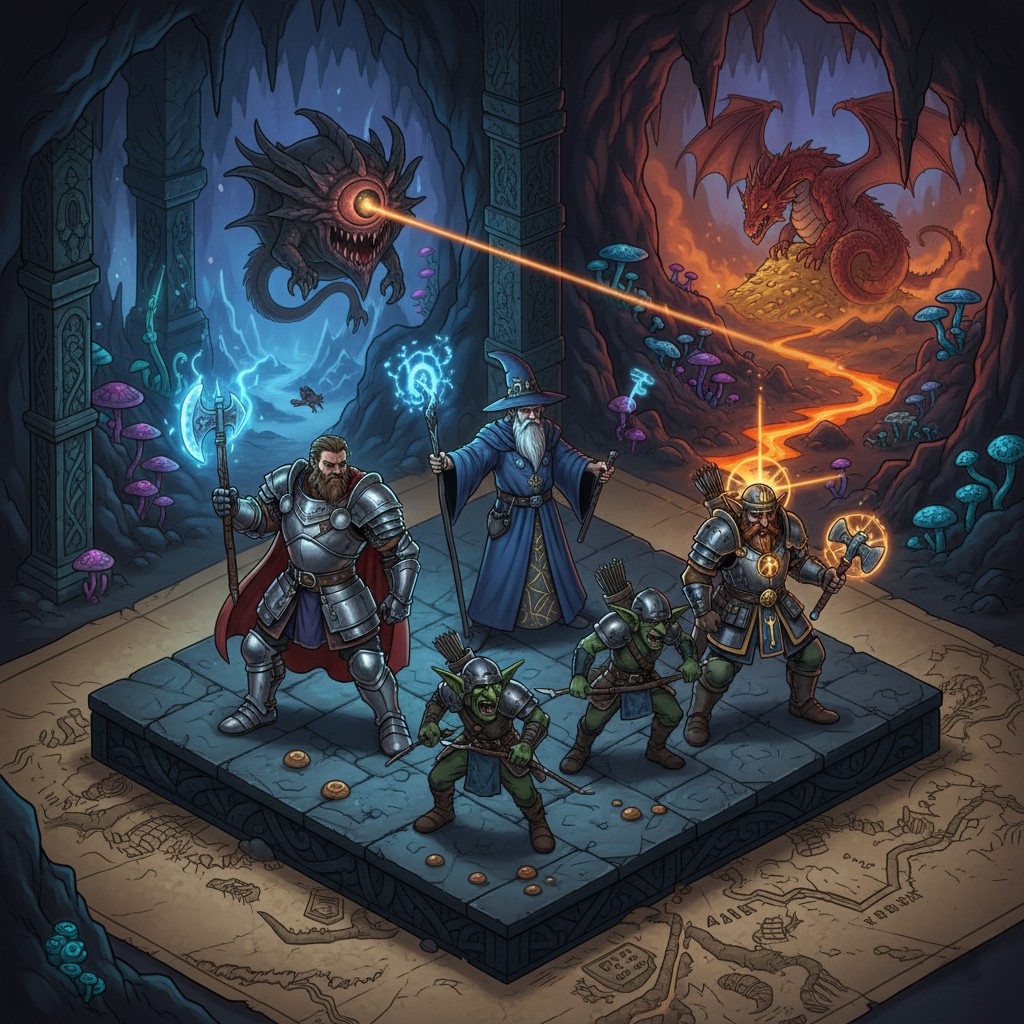
- Classes / Playbooks: The game includes archetypal fantasy classes (Fighter, Thief, Wizard, Cleric, Bard, Ranger, etc.). Each class gives simple moves, starting gear, bonds, etc. Abilities map roughly to familiar fantasy tropes but are handled in the PbtA style: less about maximizing mechanical optimization, more about how the character fits into the story.
- Progression & Experience: Experience is gained by failing rolls (6- or less), resolving bonds, treasure hunting, etc. This encourages risk, involvement in the story, and accepting consequences rather than avoiding failure.
- GM / Narrative Guidance: Dungeon World’s GM section (or Game Master, often called “GM” or “Dungeon World GM”) has strong focus on running to the fiction, improvisation, responding to player input, making moves when players fail, using fronts to push the plot. The GM doesn’t roll dice in many situations; the GM’s “moves” are triggered by player failures or fiction.
- Gear, Magic, Monsters: While preserving fantasy staples—spells, magical items, monsters—Dungeon World tends toward simpler and more narratively described traits. Monsters are less about heavy stat blocks and more about what makes them dangerous and what they do / where they are.
🎯 What It Performs Well
Here are the strengths that players and reviewers often point out:
- Narrative momentum & pacing: Because failure yields consequences (often interesting narrative complications) rather than dead-ends, the story tends to keep moving. Dungeon World avoids “rules tax” moments common in more simulationist RPGs.
- Accessibility & rules-light approach: New players often find it easier to pick up than many D&D editions. There isn’t a single sprawling skill tree or dozens of feats to memorize. The moves and classes provide structure without overwhelming detail.
- Collaboration & player agency: Because players help define the setting, have bonds, and because many move triggers are narrative or fictional in nature, players often feel more engaged in shaping the game than simply reacting. The blank spaces, map sketches, etc., contribute to that co-creation.
- High replayability & hackability: Dungeon World is frequently praised as being easy to mod, with many third-party and fan-created supplements, monster codices, etc. Because its structure is open, GMs and players can adjust what they want (e.g. modify classes, create new moves, change magic bits) without breaking mechanics.
⚠ Trade-Offs & Limitations
Dungeon World isn’t for everyone, and various reviews and player feedback highlight a few trade-offs:
- Lack of granular difficulty scaling / challenge differentiation: Some criticism is that tasks of wildly different narrative difficulty can sometimes feel similar mechanically, since the standard 2d6 + modifier / 7-9 partial success pattern is very consistent. The system gives GMs responsibility to adjust fiction and describe stakes, but there’s less mechanical toolkit to support big scale differences.
- GM burden in improvisation: Because the system assumes a lot of fictional negotiation, improvisation, responding to player input and failures, a GM needs to be comfortable in that role. If a GM expects structured adventure paths or tight scripting, Dungeon World may feel loose.
- Combat vs non-combat tension imbalances: Some classes that are less combat-focused may feel weaker in fights; balancing encounters can sometimes require adjusting monsters or threats. Also, since class utility may shine differently based on whether the session is combat heavy or exploration / talking / magic heavy, pacing must be managed.
- Structure & expectations: Players coming from more rules heavy games may expect many details (initiative, positioning, precise effects), which Dungeon World intentionally abstracts. That can be disorienting. Also, some reviews mention that the layout or organization of the book isn’t always intuitive (e.g. finding certain moves or rules during play).
🧭 Who It’s For
Dungeon World is especially well-suited for:
- Groups who enjoy fantasy adventure but prefer more narrative and fiction-driven rules over mechanical crunch.
- Players and GMs new to roleplaying or who want something lighter and faster to run than most editions of D&D.
- Tables that value player agency, shared storytelling, co-created worlds, and emergent fiction.
- GMs who are comfortable improvising, reacting to player choices, and building setting details during play rather than preparing everything in advance.
Less ideal if:
- You want tightly balanced tactical combat with detailed mini and map positioning, precise skill resolutions, or large mechanical customization.
- You prefer heavy mechanical granularity: skill ranks, feats, detailed modifiers, etc.
- You dislike ambiguity or partial success/consequence mechanics, or want more strict mechanical rules for low-level vs high-level differences.
🔮 Final Thoughts
Dungeon World is a refreshing fusion of two strong traditions: the high-adventure fantasy of classic D&D, and the narrative, fiction-first momentum of PbtA games. It captures the joy of smashing down dungeon doors, dealing with dragons, exploring forgotten ruins—all while minimizing downtime spent in rules lookup.
Its success lies in its clarity of purpose: this is a game meant to enable dramatic fantasy, with story stakes, character relationships, and shared world-building, rather than a game that tries to be everything. Because it knows what it wants to do, it does that very well.
If you want an RPG that fires up quickly, lets the fiction breathe, leans into failure as possibility, and values improvisation over simulation, Dungeon World is one of the first games you should try. It may ask more from the GM in terms of narrative instinct and from the players in terms of embracing uncertainty — but the rewards are often stories worth telling.