
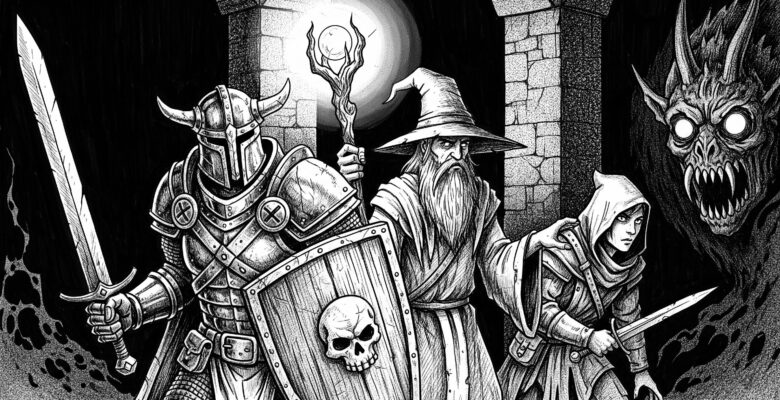
Shadowdark, created by Kelsey Dionne and published by The Arcane Library, is a modern tabletop role-playing game that wears its old-school roots proudly while embracing streamlined mechanics and elegant usability. Self-described as a bridge between “the best parts of classic and modern fantasy RPGs,” Shadowdark is both a love letter to early Dungeons & Dragons and a bold reimagining of what fast-paced, deadly dungeon-crawling can look like in the 2020s.
If you’re familiar with BX D&D, OSE, or 5E, you’ll find the DNA of all three within Shadowdark — but it’s not just a remix. It’s a refined, play-focused system that trims excess, respects player time, and prioritizes tension, speed, and thematic coherence.
System Overview
At its core, Shadowdark is a roll-high d20 system where players try to beat DCs or opposing rolls. It uses ability modifiers, armor class, and hit dice familiar to modern players, but it also returns to classic tropes such as race-as-class, Vancian spellcasting, low hit points, and brutal monster lethality.
Key Mechanics:
- Real-Time Torches: A torch lasts for one real-world hour at the table. This clever mechanic adds urgency to exploration and reinforces the survivalist tension that defines dungeon-crawling.
- Roll-to-Cast: Casters roll each time they cast a spell; on a low result, the spell is forgotten for the day. This adds unpredictability while avoiding spell slots.
- Simplified Initiative: All players roll a d20; high rolls act before the enemy. It’s fast, fair, and keeps gameplay moving.
- Zone-Based Exploration: Instead of mapping every 10 feet, Shadowdark encourages the GM to divide dungeons into zones. This abstraction speeds up gameplay without removing spatial awareness.
The rulebook comes in a digestible format: clean layout, smart indexing, and heavy use of random tables and procedural tools that keep a session rolling without prep.
Tone and Aesthetic
Shadowdark leans hard into the sword & sorcery aesthetic: dungeons are dark, gold is the goal, magic is mysterious, and the gods are distant or cruel. The setting material is minimal, designed to be modular and flexible. Instead of spelling out a fully fleshed world, the book gives you just enough inspiration to build your own.
Graphically, Shadowdark is a stunner. The art is evocative of early TSR-era fantasy, often black-and-white, but crisply modern in its composition. The production quality of the hardcover edition is high, with thick pages, ribbon bookmarks, and sturdy binding.
Strengths
⚔️ Streamlined OSR Gameplay
Shadowdark trims the bloat that has crept into both modern and old-school systems. Characters are created quickly. There are no complex subsystems. Even magic items are simple and flavorful.
🕯️ Real-Time Tension
The use of timers and torches to enforce exploration pacing is one of the game’s most compelling features. Knowing that the torch will go out in real-world minutes adds a visceral sense of danger and urgency. It’s not just thematic — it’s a structural design choice that enhances play.
🛠️ Toolbox for GMs
Shadowdark shines in its procedural support. It’s packed with random tables: traps, monsters, dungeon dressings, treasure hoards, names, and even complete one-page dungeons. These are not fluff — they’re genuinely useful at the table, especially during improvisation-heavy sessions.
🎲 Easy for New and Veteran Players
The mechanics are intuitive enough for newer players to pick up quickly, especially those coming from 5e, but rewarding for veterans who enjoy high-lethality gameplay and exploration challenges.
Weaknesses
🧙 Spellcasting is Punishing
While the “roll-to-cast” mechanic adds unpredictability, it can feel frustrating for players who invest in magic. A single failed roll can end a wizard’s usefulness for the day. Some GMs may feel pressure to soften this rule for the sake of balance.
💰 Gold-for-XP Economy (Optional) Isn’t Fully Explored
The traditional OSR principle of earning XP through gold is referenced but not deeply developed. It leaves some ambiguity around progression pacing and campaign design. GMs unfamiliar with the OSR may need to do extra work to decide how advancement should work in practice.
🧱 No Default Setting
For some players, the lack of a defined world is freeing. For others — especially those coming from 5e — the absence of a setting like the Forgotten Realms or Eberron means more prep work. However, the modular style of Shadowdark makes it compatible with any fantasy setting.

Comparison to Other Systems
| System | What Shadowdark Does Differently |
|---|---|
| 5e D&D | Faster combat, higher lethality, no multiclassing, and less mechanical granularity. |
| Old-School Essentials | Adds modern quality-of-life improvements like roll-high mechanics and unified task resolution. |
| Dungeon World / PbtA | Less narrative abstraction — Shadowdark focuses on concrete actions, dungeon logistics, and old-school danger. |
Who Is Shadowdark For?
Ideal Players:
- Fans of classic D&D who want a more usable modern version.
- New players overwhelmed by 5e’s character options.
- GMs who like procedural generation, sandbox play, and dungeon-delving.
Maybe Not For:
- Players who prefer high-powered heroes and cinematic combat.
- Groups looking for heavily narrative or story-first systems.
- Magic-focused players expecting long spell lists or customization.
Conclusion
Shadowdark is one of the most successful OSR-modern hybrids available today. It takes the sharp, deadly core of classic dungeon crawls and wraps it in a fast, accessible, and well-presented package. Whether you’re running one-shots or long-form campaigns, it delivers a tense, tactical, and tightly paced experience that celebrates the essence of fantasy RPGs.
If you’re looking for a streamlined, torch-lit plunge into ancient ruins — one where every torch matters and every corridor could kill — Shadowdark may be exactly the dungeon you’ve been waiting to explore.