
Publisher: Brotherwise Games, in partnership with Dragonsteel Entertainment
Game: The Cosmere Roleplaying Game
Setting: Scadrial, from Brandon Sanderson’s Mistborn novels
Adventure: Campaign-length adventure spanning Mistborn Eras One and Two
What legacy will you leave behind?
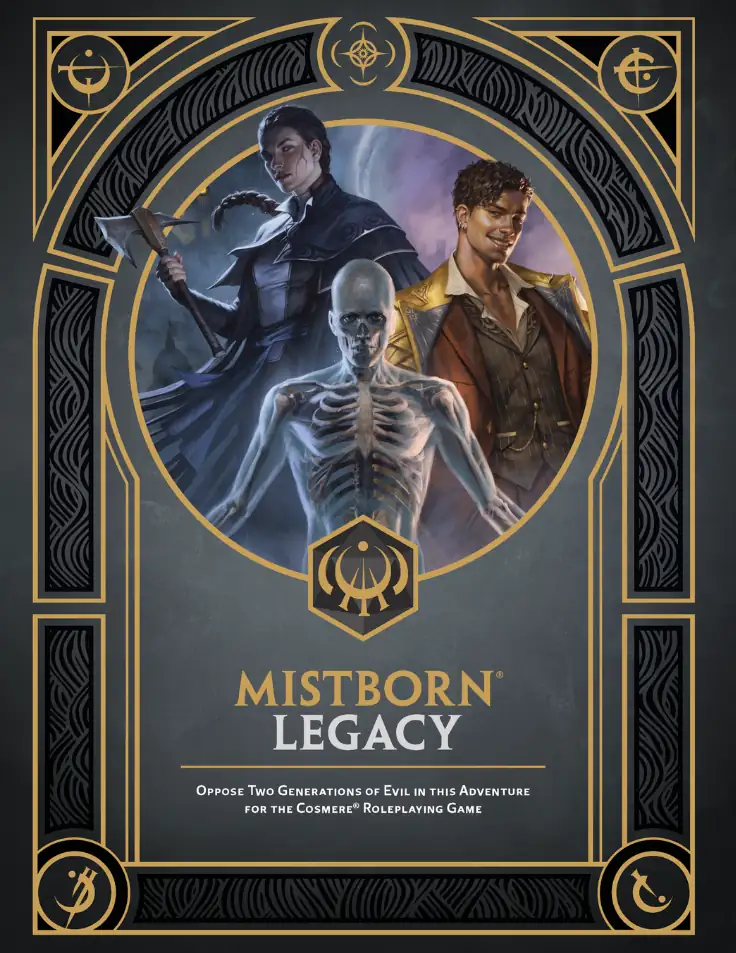
The Cosmere RPG: Mistborn Legacy takes an ambitious approach to tabletop campaign design: rather than following one adventuring party through a conventional progression, it tells a story across generations, with two separate groups of characters whose actions are connected by the passage of centuries.
The adventure begins during the fall of the Final Empire. A group of heroes becomes entangled in the rise of the Gilded Few, a dangerous organization seeking the Eternity Spike—an artifact intended to empower a new Lord Ruler. The first party’s decisions shape events that unfold long afterward, when a new generation of heroes must confront the consequences.
This is the first campaign-length adventure for the Mistborn setting in the Cosmere RPG, and its two-era structure is its defining feature. Brotherwise Games has built the adventure around the idea that characters can leave a lasting mark on the world, even after their own stories have ended.
🏰 The Story: Two Generations, One Conflict
The campaign opens as the Final Empire approaches its downfall. While the world is already facing enormous upheaval, a new threat emerges: the Gilded Few, who seek the Eternity Spike, an artifact capable of empowering a new Lord Ruler. Their ambitions provide the central conflict connecting the adventure’s two eras.
Era One takes characters from levels 1–6. This portion of the campaign features ballroom intrigue, horrific secrets, and the Siege of Luthadel. These ingredients offer a mixture of social encounters, investigation, danger, and large-scale conflict. The setting is well suited to stories in which a seemingly ordinary crew becomes caught up in events that could reshape the entire empire.
Era Two introduces an entirely new party, progressing from levels 3–9. Rather than continuing with the original heroes, the campaign jumps forward centuries. The new characters must undertake a treasure hunt and thwart the schemes of powerful, unscrupulous nobles. The consequences of the earlier party’s decisions become part of the world they inherit.
This structure is the adventure’s most interesting design choice. The passage of time is not simply a narrative device used to change the scenery. It is central to the campaign’s identity: the players experience the world before and after a major historical transformation, with their earlier accomplishments and failures helping shape the later story.
🧬 The Legacies Mechanic
The signature feature is the Legacies mechanic, which gives each player individual choices and spotlight scenes that affect their characters’ descendants. Brotherwise describes these as special roles connecting the two eras and creating unique character moments for everyone at the table.
This is an appealing way to make the generational structure meaningful for the players. In a typical campaign, a character’s story ends when that character retires, dies, or the adventure concludes. Here, the story can continue through the influence that character leaves behind.
The mechanic also gives players a personal stake in the time jump. Rather than having the Game Master simply announce what happened during the intervening centuries, the campaign provides opportunities for individual decisions to contribute to the legacy inherited by the next party.
Brotherwise has not publicly detailed every Legacy role or the complete procedure for resolving these choices in its product description. Still, the stated design goal is compelling: each player receives moments of individual importance, and those decisions have consequences beyond the original character’s lifetime.
The concept is particularly appropriate for Mistborn. The novels frequently explore the long-term consequences of individual actions, the way history is remembered, and how later generations interpret the deeds of those who came before them. This mechanic gives a tabletop group a chance to explore those themes through its own characters.
🗺️ Locations and Downtime
The official description specifically identifies downtime rules and locations for Luthadel and Elendel.
These two cities provide natural anchors for the campaign’s different periods. Luthadel is closely associated with the Final Empire and the first era’s political intrigue and upheaval. Elendel represents the changed world of Era Two, where the later party pursues its objectives in a very different society.
Downtime is also a useful inclusion in a campaign built around long-term consequences. It gives the adventure a way to account for activity between major events, rather than making the experience exclusively about moving from one encounter to the next.
The publisher’s description does not provide a complete breakdown of the downtime procedures or a detailed inventory of the locations included. Consequently, the precise depth of these resources is difficult to judge without examining the full adventure. Nevertheless, their inclusion suggests that the book is intended to support more than a sequence of scripted encounters.
🎭 Campaign Style and Game Master Appeal
Mistborn Legacy has several distinct adventure ingredients. The first era combines social intrigue, disturbing discoveries, and a major siege. The second shifts toward a treasure hunt and opposition from powerful nobles. That variety should help keep the campaign from feeling like one extended combat sequence.
The two-party format also gives the Game Master an unusual storytelling opportunity. Events can be presented from different historical perspectives, and information revealed in the first era can take on new significance when the story resumes centuries later.
The central mystery surrounding the Eternity Spike provides a recognizable thread through both periods. It gives the campaign a clear antagonist-driven objective while leaving room for the players’ decisions to influence the outcome.
Brotherwise has also indicated that the adventure introduces new villains and reveals additional canonical details about the setting. That is a welcome feature for fans of the novels, although the publisher’s public description does not identify those revelations or provide a full list of the new characters.
📖 Requirements and Place in the Cosmere RPG
This is a campaign adventure, not a standalone roleplaying game or replacement for the Mistborn core rules. The Mistborn Handbook is required to play. That book provides the rules and character options for the Scadrial setting, while Mistborn Legacy supplies the campaign itself.
It is also the first campaign-length adventure for the Mistborn Campaign Setting. Groups looking for a structured introduction to a longer Scadrial campaign therefore have a clear starting point, with character advancement beginning at level 1 and continuing through level 9 across the two parties.
The campaign’s unusual structure does require some commitment. Players should be comfortable with the idea that their first characters will not remain the protagonists for the entire adventure. The later portion asks them to create a new group and experience the consequences of the earlier party’s actions from a different point in history.
That is a distinctive strength, but it may not suit every group. Players who become deeply attached to a single character and prefer a continuous campaign following that character’s personal development may find the generational transition less appealing. Groups who enjoy interconnected stories, historical consequences, and changing perspectives may find it especially rewarding.
⭐ Strengths and Considerations
Strengths
- A campaign that spans both Mistborn Era One and Era Two.
- Two separate parties, with character advancement from levels 1–6 and 3–9 respectively.
- The Legacies mechanic connects individual player decisions to future generations.
- A compelling central conflict involving the Gilded Few and the Eternity Spike.
- Varied adventure elements, including ballroom intrigue, horrific secrets, a siege, and a treasure hunt.
- Downtime rules and locations for Luthadel and Elendel.
- New villains and additional canonical setting details.
Considerations
- Requires the Mistborn Handbook; it is not a standalone game.
- The transition to a new party may not appeal to groups who want to follow one set of characters throughout a campaign.
- The two-era structure asks the Game Master to manage a more complex narrative than a conventional single-party adventure.
- The public product description does not fully explain the Legacy roles or detail every adventure chapter, so the depth of those mechanics is difficult to assess before purchase.
🏆 Final Verdict
Cosmere RPG: Mistborn Legacy offers a genuinely distinctive campaign concept. Its two-era structure and Legacies mechanic give it an identity beyond simply adapting the events and atmosphere of the Mistborn novels into tabletop encounters. Players do not just explore Scadrial; they get to influence its history and then experience the consequences through a new generation of heroes.
The combination of political intrigue, dark secrets, large-scale conflict, and a later treasure hunt also promises a varied campaign. The central mystery of the Eternity Spike gives the story a strong connecting thread, while the shift between Luthadel and Elendel provides an opportunity to experience two very different versions of Scadrial.
The main caveat is that the campaign’s generational structure will not appeal to everyone. Replacing the original party with a new group is a significant departure from traditional character-focused campaigns. It also requires the Mistborn Handbook, so prospective buyers should account for that additional purchase.
Overall, Mistborn Legacy looks like one of the more imaginative campaign offerings in the Cosmere RPG line. For groups who enjoy long-form storytelling, meaningful player choices, and seeing how their actions reshape a fictional world over time, this adventure should be an especially appealing way to explore Scadrial.