
Publisher: Brotherwise Games, in partnership with Dragonsteel Entertainment
Game: The Cosmere Roleplaying Game
Setting: Scadrial, from Brandon Sanderson’s Mistborn novels
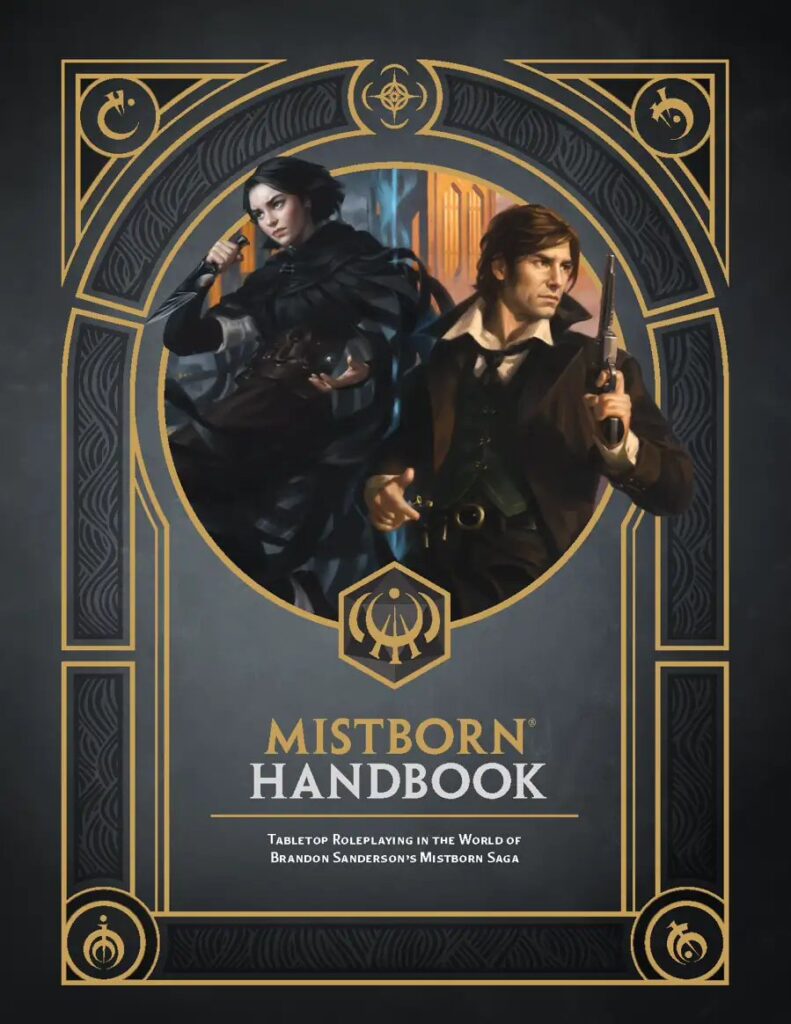
Format: 405-page hardcover core rulebook, with PDF availability
The Cosmere RPG: Mistborn Handbook brings one of Brandon Sanderson’s most distinctive fantasy settings into the Cosmere Roleplaying Game. Rather than simply adapting the novels’ characters and powers into a conventional fantasy RPG, Brotherwise Games uses the setting as the foundation for a full campaign experience spanning both eras of Mistborn. Players can explore the oppressive, ash-covered world of the Final Empire or jump forward to a more technologically advanced Scadrial of railways, automobiles, airships, and gunslingers.
This is a substantial setting-specific core rulebook, not merely a collection of character options for the existing game. It provides the rules needed to create characters and play in the Mistborn campaign setting, while building on the Cosmere RPG’s d20-based system and its distinctive narrative mechanics. Its biggest appeal is the opportunity to experience the Metallic Arts at the gaming table, with character development and action shaped by the same themes of ingenuity, personal struggle, and consequential choices that define the novels.
🌫️ Setting and Atmosphere
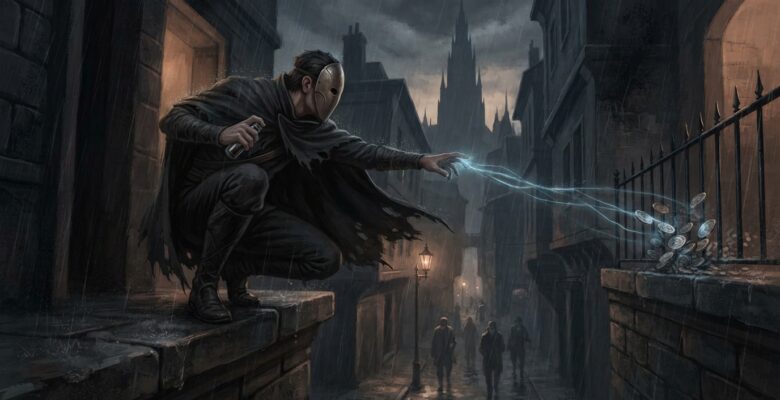
One of the strongest features of the Mistborn Handbook is its support for two very different campaign styles within the same setting. Era One takes place under the oppressive rule of the Final Empire, where ash falls from the sky, the skaa live under brutal oppression, and the nobility maintain their power through privilege and fear. This era naturally supports stories involving rebellion, infiltration, political maneuvering, dangerous heists, and the mysteries surrounding the Lord Ruler.
Era Two offers a substantial change in tone. Centuries after the fall of the Final Empire, Scadrial has developed into a more technologically advanced society. Railways, automobiles, airships, and skyscrapers provide a backdrop for adventures involving detective work, secret societies, gunslingers, and emerging political tensions.
The ability to run campaigns in either era is a major selling point. Groups can choose the darker, more desperate atmosphere of the original trilogy or the more adventurous, occasionally western-inspired flavor of the later novels. Both settings retain the distinctive Metallic Arts and the larger conflicts involving powerful divine forces.
The two eras also offer opportunities for different character concepts and campaign structures. A group might play a crew of criminals planning an elaborate job in the Final Empire, or a band of investigators uncovering a conspiracy in the increasingly modern world of Era Two. The handbook is designed to support both approaches rather than treating one as an afterthought.
🎲 The Plotweaver Rules System
The Cosmere RPG uses a d20-based system, but it adds several mechanics intended to give ordinary skill checks more narrative weight. Players roll a twenty-sided die, add the relevant attribute and skill values, and compare the result against a difficulty or an opponent’s defense.
The most distinctive addition is the Plot Die, a custom six-sided die used when a character attempts something especially risky or consequential. Its faces can generate either an Opportunity or a Complication. Opportunities provide openings for useful effects, while Complications introduce setbacks or unexpected developments. These results are not simply another way to succeed or fail; they give the Game Master and players tools for introducing interesting consequences into the unfolding story.
The system also rolls the dice for a test together rather than requiring a sequence of separate rolls. Depending on the situation, this can include the d20, Plot Die, damage dice, and additional dice for advantages or disadvantages. The result is intended to keep important moments moving while allowing dramatic twists to emerge naturally.
Another interesting feature is the game’s use of three categories of character attributes: Physical, Cognitive, and Spiritual. These encompass six attributes—Strength, Speed, Intellect, Willpower, Awareness, and Presence. Rather than relying on a single defense value comparable to Armor Class in many d20 games, characters have Physical, Cognitive, and Spiritual defenses. This makes it possible to challenge characters through physical attacks, mental pressure, or spiritual and social influence.
Characters also manage three resource pools: Health, Focus, and Investiture. Health represents physical endurance, Focus supports mental effort and many talents, and Investiture fuels the supernatural abilities of characters who possess them. This gives the system a useful distinction between physical survival, mental resilience, and magical power.
These mechanics make the Cosmere RPG feel familiar to players experienced with d20 games while giving it a recognizable identity of its own.
⚔️ Combat and Action
Combat uses a structured system that aims to keep encounters fast-paced and character-driven. At the beginning of each round, player characters and NPCs choose between taking a fast or slow turn. Fast turns provide two actions, while slow turns provide three. The order in which these turns occur creates tactical decisions about when to act and how to coordinate with the rest of the group.
Characters can also use reactions, and powerful boss adversaries have additional flexibility in their turns. Attacks are resolved against the appropriate defense, and successful attacks add the relevant skill modifier to their damage dice. Even a missed attack can sometimes deal reduced damage through the option to spend Focus and graze an opponent.
Critical hits and injuries add further consequences. A natural 20 on an attack test generates an Opportunity that can be spent to produce a critical hit, maximizing the damage dice. Characters reduced to zero Health suffer an injury, making combat more consequential than simply tracking a dwindling pool of hit points.
The three-defense structure is particularly appropriate for Mistborn. Not every confrontation needs to be resolved through a sword fight or gun battle. Social manipulation, deception, intimidation, and supernatural influence can all challenge characters in ways that physical armor cannot solve.
The rules overview also identifies three broad scene types: Combats, Conversations, and Endeavors. Conversations handle social conflicts and attempts to influence NPCs, while Endeavors cover cooperative skill-based challenges such as chases, extended tasks, and montage-style sequences. This broader approach helps the game support the heists, investigations, political maneuvering, and personal drama that are central to the setting.
🧙 Character Creation and the Metallic Arts
Character development is arguably the handbook’s biggest attraction. Instead of traditional character classes, the Cosmere RPG uses flexible paths made up of talent trees. The six core heroic paths are Agent, Envoy, Hunter, Leader, Scholar, and Warrior. These provide broad character concepts without forcing players into rigid class structures.
The Mistborn setting adds five playable Metalborn paths, supporting characters who possess Allomantic or Feruchemical abilities. The official rules overview identifies 34 playable Allomantic and Feruchemical powers across these options. Characters can develop through their chosen talent trees and combine paths through multipathing, allowing for more individualized builds.
This is particularly important for adapting the novels’ magic system. The Metallic Arts are not generic spellcasting: Allomancers burn metals to produce specific supernatural effects, while Feruchemists store attributes in metals and draw upon them later. Twinborn combine aspects of both traditions. The handbook provides new paths for Mistborn, Mistings, Feruchemists, Ferrings, and Twinborn, bringing these distinctive abilities into the game’s character progression.
Brotherwise also highlights eight new heroic specialties, including the Hazekiller and Rebel. These additions help support characters who are not necessarily powerful Metalborn but still have important roles in the dangerous world of Scadrial. The result is a broader range of potential adventurers than a game focused exclusively on magical protagonists might otherwise provide.
📚 A Core Book for the Mistborn Campaign
The Mistborn Handbook is designed to provide the rules necessary to play in either Mistborn era. It is also an important part of a larger product line: Brotherwise identifies it as required for most Mistborn supplements, guides, and adventures.
That distinction matters when considering the book’s place in the Cosmere RPG. It is not simply an optional setting expansion for groups that already own the Stormlight material. It is the core rules book for the Mistborn campaign setting. The publisher directs Game Masters toward the Mistborn World Guide for additional setting information and the Mistborn Legacy adventure for a longer campaign experience.
This division of material gives the product line room to expand, but it also means prospective buyers should understand that the Handbook is the starting point rather than the entire Mistborn RPG library. Groups primarily interested in additional lore, history, and setting details may want to investigate the World Guide as well.
🎨 Presentation and Overall Appeal
The Cosmere RPG has a strong visual identity, and the Mistborn line carries that presentation into a darker, more atmospheric setting. The publisher’s promotional material emphasizes the distinctive black-and-gold visual styling shared by the Mistborn books, reinforcing the connection between the game and the novels.
The setting itself provides an unusually rich foundation for tabletop adventures. The contrast between the ash-covered Final Empire and the industrializing world of Era Two gives Game Masters two recognizable but distinct campaign environments. The Metallic Arts also provide a strong mechanical theme around which characters, encounters, and stories can be built.
Perhaps most importantly, the game does not appear to rely solely on recreating famous scenes from the books. Its paths, specialties, flexible character development, and different scene structures provide tools for creating original crews and adventures within Sanderson’s world.
⭐ Strengths and Considerations
Strengths
- Supports both Mistborn Era One and Era Two in one core rulebook.
- Distinctive Metallic Arts character options, including Mistborn, Mistings, Feruchemists, Ferrings, and Twinborn.
- Flexible talent-tree progression instead of rigid character classes.
- The Plot Die creates opportunities for narrative twists and complications.
- Physical, Cognitive, and Spiritual defenses support a wider range of conflicts.
- Combat, Conversations, and Endeavors give the game several ways to handle challenges beyond traditional battles.
Considerations
- Groups unfamiliar with the Cosmere RPG will need to learn its particular combination of d20 tests, resources, defenses, and Plot Die results.
- The flexible character paths and Metalborn options may require some planning to understand how different abilities work together.
- The Handbook is a core rules purchase, not a complete replacement for every supplementary setting and adventure resource.
- Groups should decide which Mistborn era best suits their preferred campaign tone before beginning.
🏆 Final Verdict
The Cosmere RPG: Mistborn Handbook looks like a strong adaptation of one of modern fantasy’s most distinctive settings. Its greatest achievement is the way it connects the Metallic Arts to a flexible character-development system while providing meaningful support for both eras of Scadrial. The Plot Die, three-defense structure, resource pools, and talent-tree progression give the game a recognizable mechanical identity without abandoning the accessibility of a d20 foundation.
The two campaign eras are another major advantage. Few settings offer such a clear contrast between dark fantasy rebellion and more technologically advanced pulp adventure while retaining a coherent magical foundation. That variety should give Game Masters considerable room to develop campaigns with very different atmospheres.
The main caveat is that this is a substantial rules commitment, and players should not mistake the Handbook for a complete collection of every Mistborn setting resource. Nevertheless, for groups who want to experience the world of Scadrial through tabletop roleplaying, this is an appealing foundation.
Overall, the Mistborn Handbook is a compelling addition to the Cosmere RPG and an especially attractive choice for fans who want to build their own crews, explore the Metallic Arts, and tell original stories in Brandon Sanderson’s world.